Politics
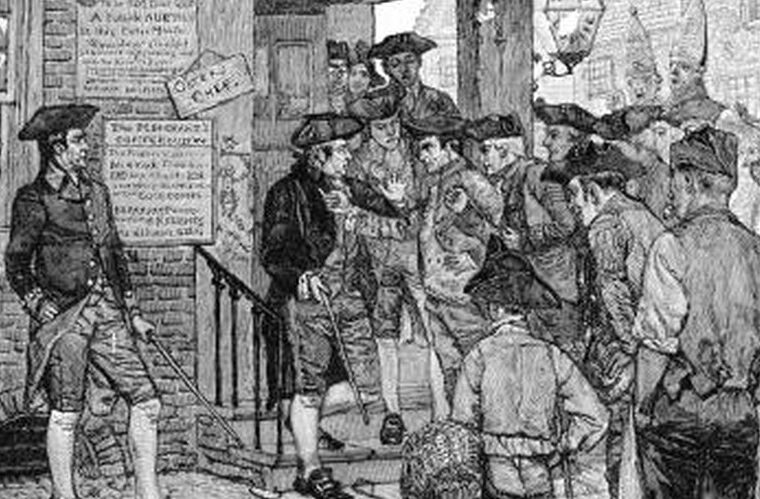
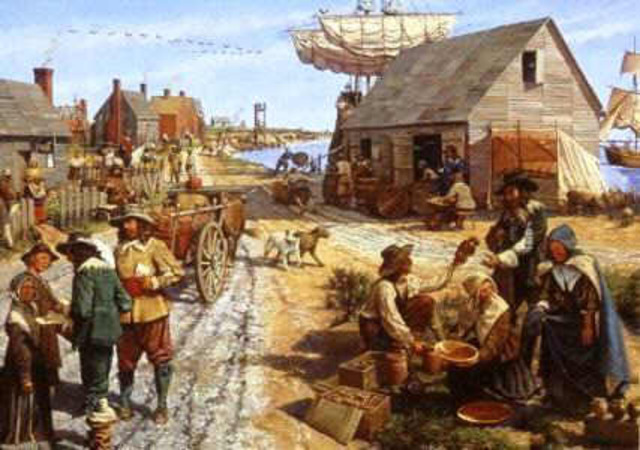 If you travel to a different area of the country or even other English-speaking areas of the world, you will find that here are different accents and even that words are used differently. Still, just because you are visiting or move to those places, doesn’t mean that you will immediately take on those accents, or their use of words. Nevertheless, when you move to a different region, your use of the language does immediately begin to evolve, whether you realize it or not, and whether it is intentional or not. The first Englishmen to set foot on American soil with the intent to colonize the land were no exception. The language began to evolve almost immediately….and it remains a fluid, almost living process to this day. “Americanisms” have been created or changed from other English terms to produce a language that very much differs from our forefathers, signifying our uniqueness and independence.
Of course, the people didn’t notice the changes right away, but by 1720, the English colonists began to notice that their language was quite different from that spoken in their Motherland. I’m sure they wondered just how that came to be? Basically, when you hear new “slang” words, and people don’t hear the accents spoken as well, the whole dynamic of the language changes. Also, very formal words like “thee, thou, and such” might become too cumbersome and so they are discarded. Everyone in the colonies knew that English would be our native language by 1790, because when the United States took its first census, there were four million Americans, 90% of whom were descendants of English colonists. So, it made perfect sense.
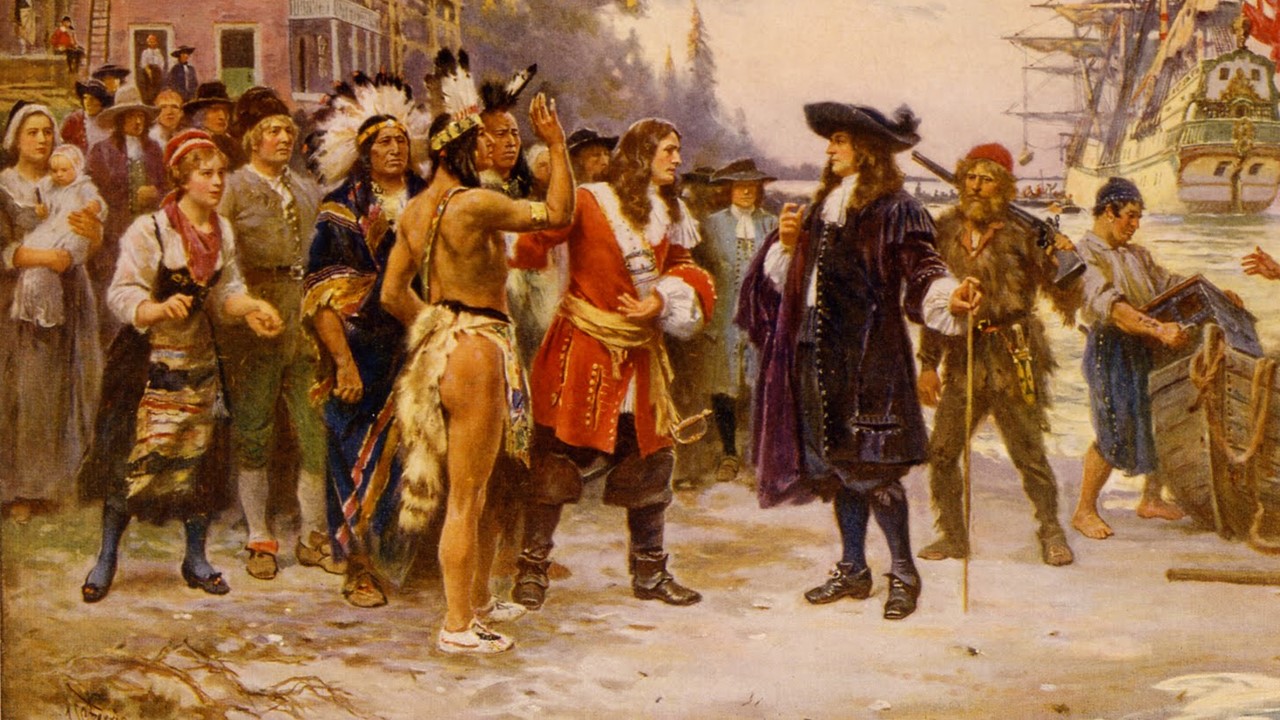
Nevertheless, it would not be the same as that spoken in Great Britain. The reasons are varied, but the most obvious reason was the sheer distance from England. The main way the language evolved was that over the years, many words were borrowed from the Native Americans, as well as other immigrants from France, Germany, Spain, and other countries. In addition, words that became obsolete “across the pond” continued to be utilized in the colonies. In other cases, words simply had to be created in order to explain the unfamiliar landscape, weather, animals, plants, and living conditions that these early pioneers encountered. By 1790 it was obvious that American English would be a very different language that British English.
The first “official” reference to the “American dialect” was made in 1756 by Samuel Johnson, a year after he published his Dictionary of the English Language. Johnson’s use of the term “American dialect” was not meant to simply explain the differences but rather, was intended as an insult. This “new” language was called “barbarous” and referred to our “Americanisms” as barbarisms. Because of the dissention between England and the Colonies, the British sneering at our language continued for more than a century after the Revolutionary War. They laughed and condemned as unnecessary, hundreds of American terms and phrases, but to our newly independent Americans, they were proud of their “new” American language and considered it to be another badge of independence. In 1789, Noah Webster wrote in his Dissertations on the English Language, “The reasons for American English being different than English English are simple…As an independent nation, our honor requires us to have a system of our own, in language as well as government.” In the eyes of the Colonists, that settled the matter, and when the United States was formed, the new nation was proud to be separated for the “Motherland” and would have it no other way.
Our leaders, including Thomas Jefferson and Benjamin Rush, agreed — it was not only good politics, but it was also sensible. The most atrocious changes to the British were the heavy use of contractions such as ain’t, can’t, don’t, and couldn’t. The feelings of the “rest of the world” didn’t matter to Americans, and the language changed even more during the western movement as numerous Native American and Spanish words became an everyday part of our language. The evolution of the American language continued into the 20th century and really continues even to this day. After World War I, when Americans were in a patriotic and anti-foreign mood, the state of Illinois went so far as to pass an act making the official language of the state the “American language.” In 1923, in the State of Illinois General Assembly, they passed the act stating in part, “The official language of the State of Illinois shall be known hereafter as the ‘American’ language and not as the ‘English’ 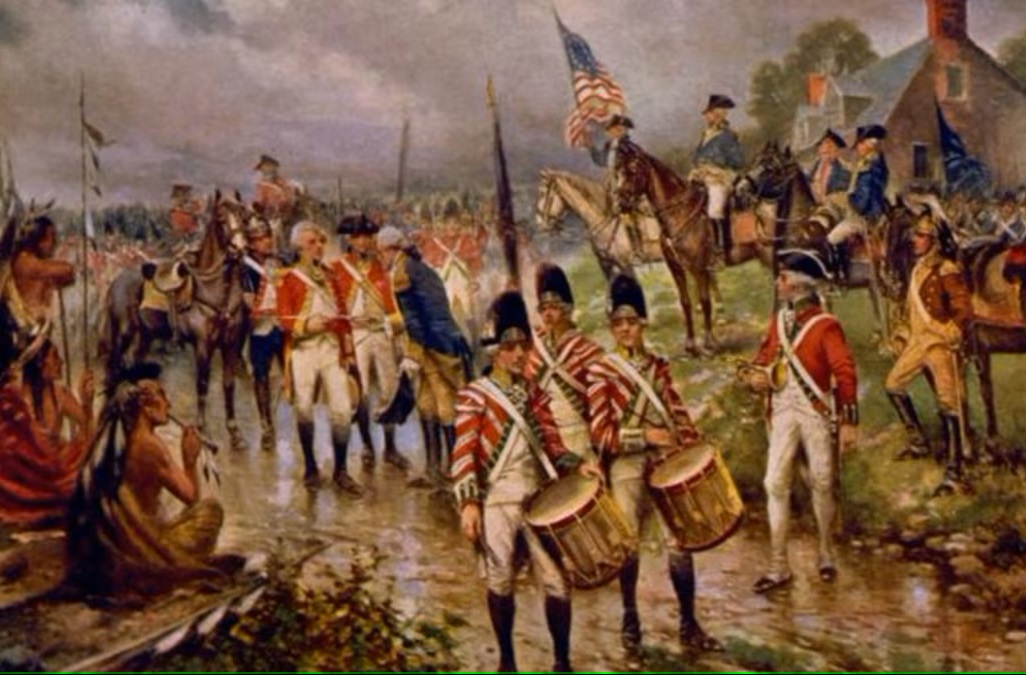
 language. A similar bill was also introduced in the US House of Representatives the same year but died in committee. Ironically, after centuries of forming our ‘own’ language, the English and American versions are once again beginning to blend as movies, songs, electronics, and global traveling bring the two ‘languages’ closer together.”
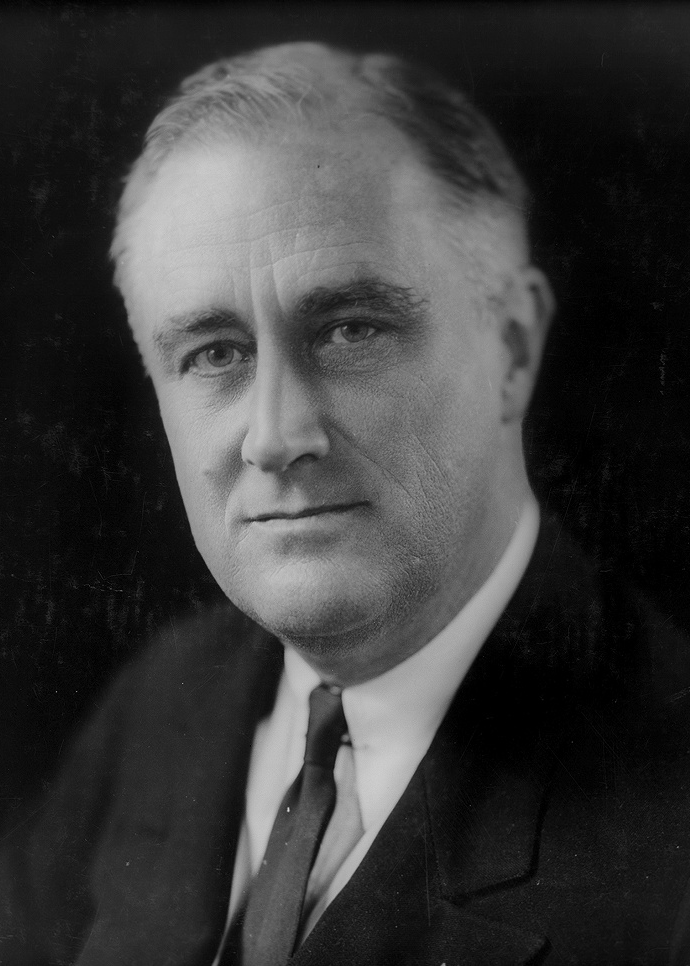
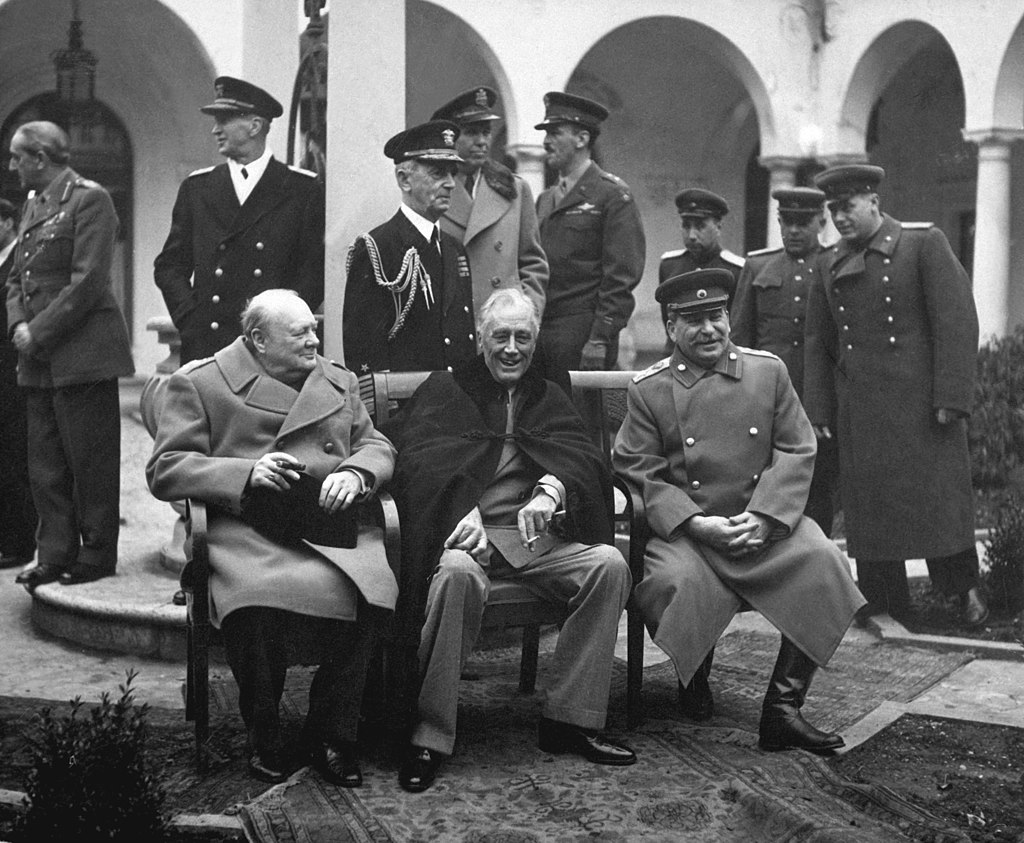 What was known as the Yalta Conference, was held February 4 – 11, 1945. It was a meeting of the heads of government of the United States, the United Kingdom, and the Soviet Union, during World War II, to discuss the postwar reorganization of Germany and Europe, because it was becoming more and more evident that the war was winding down, and the Allies would be the victors. Representing the United States was President Franklin D Roosevelt. Prime Minister Winston Churchill represented the United Kingdom, and the Soviet Union was represented by General Secretary Joseph Stalin. Yalta is located in Crimea, Soviet Union, within the Livadia, Yusupov, and Vorontsov palaces.
As a war comes to a close, there must be some kind of a postwar strategy for shaping how the defeated nation will move into peacetime. They cannot be allowed to continue in the same direction that led to war in the first place, and the nations who won the victory will be key players in the newly formed alliance. They needed to shape a postwar peace that represented not only a collective security order, but also a plan to give self-determination to the liberated peoples of Europe, following years of oppression. The conference was intended mainly to discuss the re-establishment of the nations of war-torn Europe. Unfortunately, within a few years, and with the Cold War dividing the continent, the conference became a subject of intense controversy. There was a total of three conferences during World War II. They were known as the Big Three, and Yalta was the second one. The first was the Tehran Conference in November 1943 and the third was the Potsdam Conference in July of the same year as the Yalta Conference…1945. It was also preceded by a conference in Moscow in October 1944, not attended by Roosevelt, in which Churchill and Stalin had spoken about Western and Soviet spheres of influence in Europe.
Finally, on February 11, 1945, after a week of intensive bargaining by the three leaders of the Allied powers, the conference in Yalta ended. While the Yalta Conference was in session, the Western Allies liberated all of France and Belgium and were fighting on the western border of Germany. In the east, Soviet forces were 40 miles from Berlin, having already pushed back the Germans from Poland, Romania, and Bulgaria. These operations proved without a doubt that a German defeat was imminent. So, the focus moved toward shaping postwar Europe. With victory over Germany three months away, Churchill and Stalin were more intent on dividing Europe into zones of political influence than in addressing military considerations. Germany was to be divided into four occupation zones administered by the three major powers and France and was to be thoroughly demilitarized and its war criminals brought to trial. The Soviets were given the duty to administer those European countries they liberated but promised to hold free elections. The British and Americans would oversee the transition to democracy in countries such as Italy, Austria and Greece. Final plans were made for the establishment of the United Nations. A charter conference was scheduled for April in San Francisco.
President Roosevelt, just two months from his death, concentrated his efforts on gaining Soviet support for the United States war effort against Japan. The secret United States atomic bomb project had not yet tested a weapon, and it was estimated that an amphibious attack against Japan could cost hundreds of thousands of American lives. Stalin agreed, after being assured of an occupation zone in Korea, and possession of Sakhalin Island and other territories historically disputed between Russia and Japan, to enter the Pacific War within two to three months of Germany’s surrender. Most of the Yalta accords remained secret until after World War II, and the items that were revealed, such as “Allied plans for Germany and the United Nations, were generally applauded. Roosevelt returned to the United States exhausted, and when he went to address the U.S. Congress 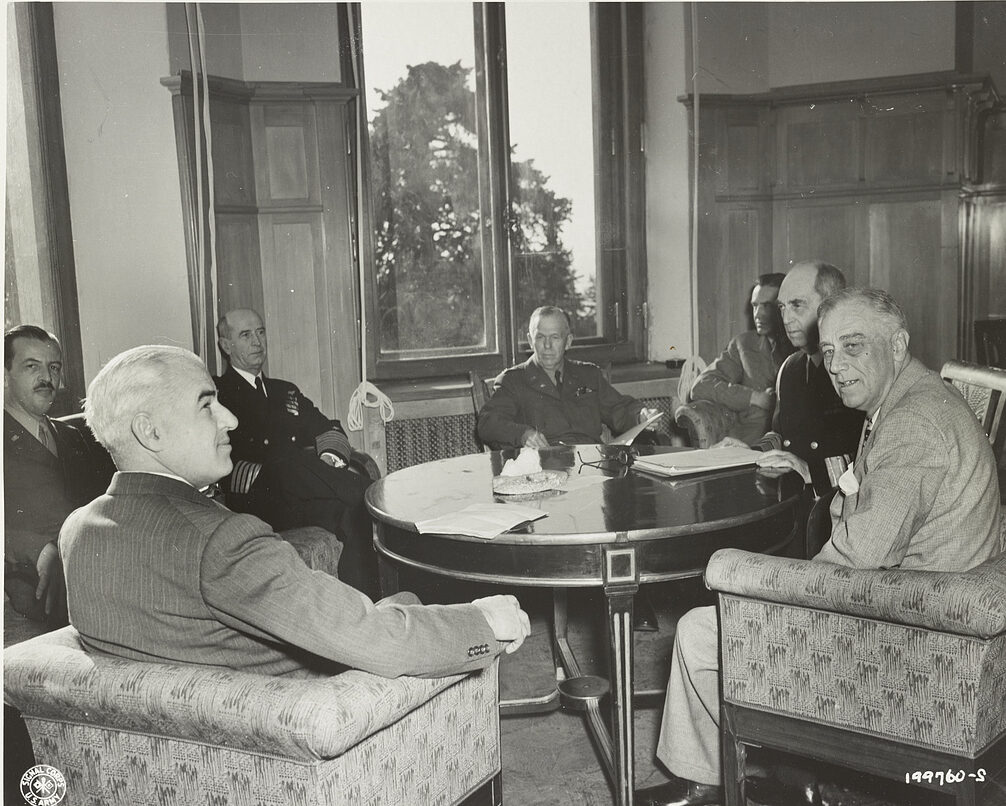
 on Yalta, he was no longer strong enough to stand with the support of braces. In that speech, he called the conference ‘a turning point, I hope, in our history, and therefore in the history of the world.'” Unfortunately, he was too sick to recover now. Roosevelt did not live long enough to see the iron curtain drop along the lines of division laid out at Yalta. In April, he traveled to his cottage in Warm Springs, Georgia, to rest and on April 12 died of a cerebral hemorrhage.
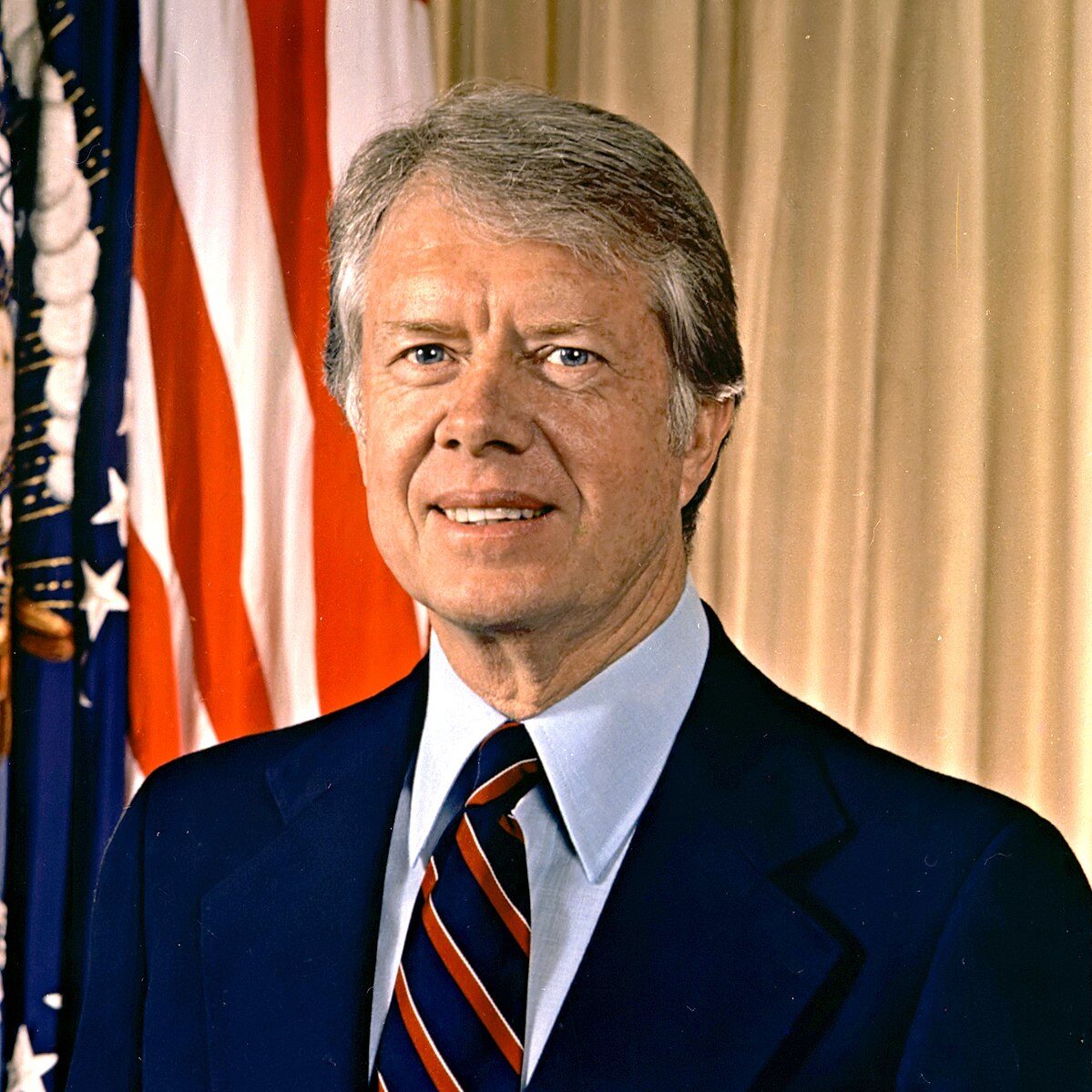
 I don’t suppose many of the young people of today would even remember the Iran Hostage Crisis, but I remember. It all started on November 6, 1979, when a group of militarized Iranian college students belonging to the Muslim Student Followers of the Imam’s Line, who supported the Iranian Revolution, took over the US Embassy in Tehran. Inside the embassy were American diplomats and citizens, and their lives were about to be forever changed. The Western media called the crisis an “entanglement of vengeance and mutual incomprehension.” US President Jimmy Carter called the hostage-taking an act of “blackmail” and the hostages “victims of terrorism and anarchy.” Of course, the Iranians view it in a much different way, calling it an act against the US and its influence in Iran, including its perceived attempts to undermine the Iranian Revolution and its long-standing support of the Shah of Iran, Mohammad Reza Pahlavi, who was overthrown in 1979. The Shah left the US in December 1979 and was ultimately granted asylum in Egypt, where he died of cancer at age 60 on July 27, 1980.
The attack did not go as it was originally planned. The students had planned a “symbolic” occupation, aimed at getting their cause before the media. The, they planned to release statements to the press and leave when government security forces came to restore order. This was documented by the placards that said, “Don’t be afraid. We just want to sit in.” Then, the embassy guards brandished firearms, so the protesters retreated. As he left, one of the students told the Americans, “We don’t mean any harm.” When it became clear that the guards would not use deadly force and that a large, angry crowd had gathered outside the compound to cheer the occupiers and jeer the hostages, the plan drastically changed. Then, according to one embassy staff member, buses full of demonstrators began to appear outside the embassy. A short time later, the Muslim Student Followers of the Imam’s Line broke through the gates. And so began the hostage crisis.
On January 27, 1980, six American diplomats who had managed to evade capture when all this began, were 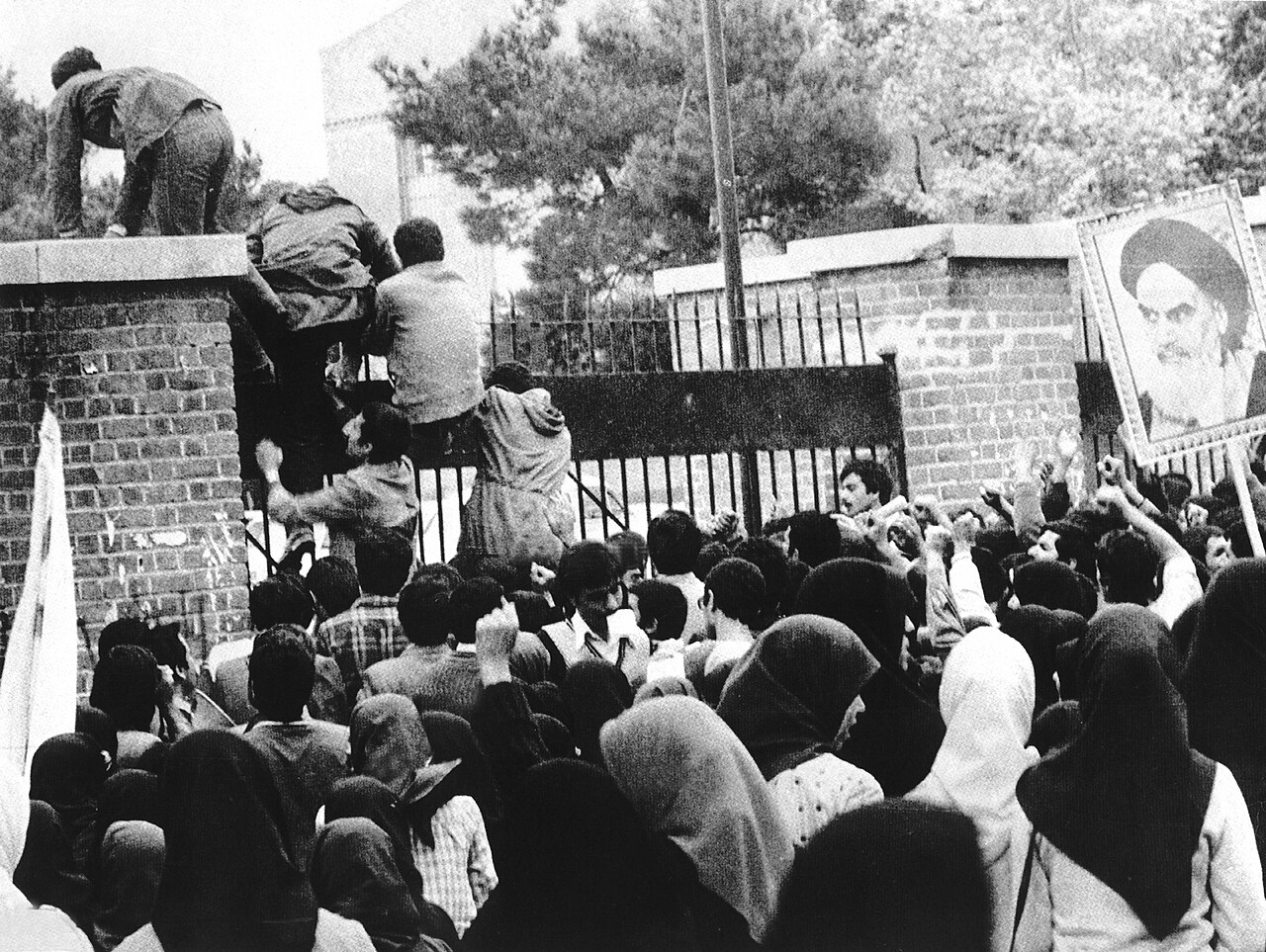 rescued by a joint CIA–Canadian effort. The crisis reached a climax in early 1980 after diplomatic negotiations failed to win the release of the hostages. President Jimmy Carter ordered the US military to attempt a rescue mission, which was called Operation Eagle Claw…using warships that included USS Nimitz and USS Coral Sea, which were patrolling the waters near Iran. That attempted rescue failed on April 24, 1980, and resulted in the death of one Iranian civilian and the accidental deaths of eight American servicemen after one of the helicopters crashed into a transport aircraft. The failure resulted in the resignation of US Secretary of State Cyrus Vance. Then, Iraq invaded Iran, beginning the Iran–Iraq War on September 1980. At that point, the Iranian government reached out to the US government, with Algeria acting as a mediator.
The hostage-takers, declaring their solidarity with other “oppressed minorities” and declaring their respect for “the special place of women in Islam,” released one woman and two African Americans on November 19, 1979. Before the release, these hostages were required by their captors to hold a press conference in which Kathy Gross and William Quarles praised the revolution’s aims and goals. Four more women and six African Americans were released the following day. According to the then United States Ambassador to Lebanon, John Gunther Dean, the 13 hostages were released with the assistance of the Palestine Liberation Organization, after Yassir Arafat and Abu Jihad personally traveled to Tehran to secure a concession. The only African American hostage that was not released that month was Charles A Jones Jr. One more hostage, a white man named Richard Queen, was released in July 1980 after he became seriously ill. He was later diagnosed with multiple sclerosis.
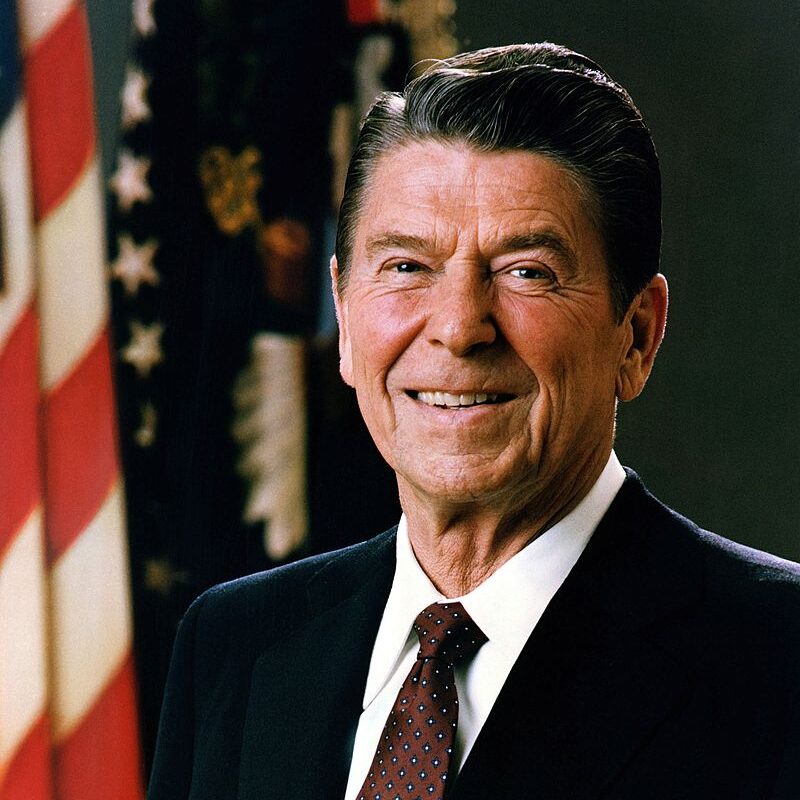
The remaining 52 hostages were held until January 20, 1981, a full 444 days of captivity. The agreed upon release came with an agreement, on January 19, 1981, in which Iran released all of the hostages and the US freed 8 billion US dollars of Iranian State assets from American banks. Then on January 20, 1981, US president-elect Ronald Reagan takes the oath of office. Just 20 minutes after Reagan’s oath, Iran released all 52 hostages, who were then flown to West Germany, by way of Algeria where former US president Jimmy Carter takes them back to the United States. Some people saw the release in a bit of a conspiracy light, 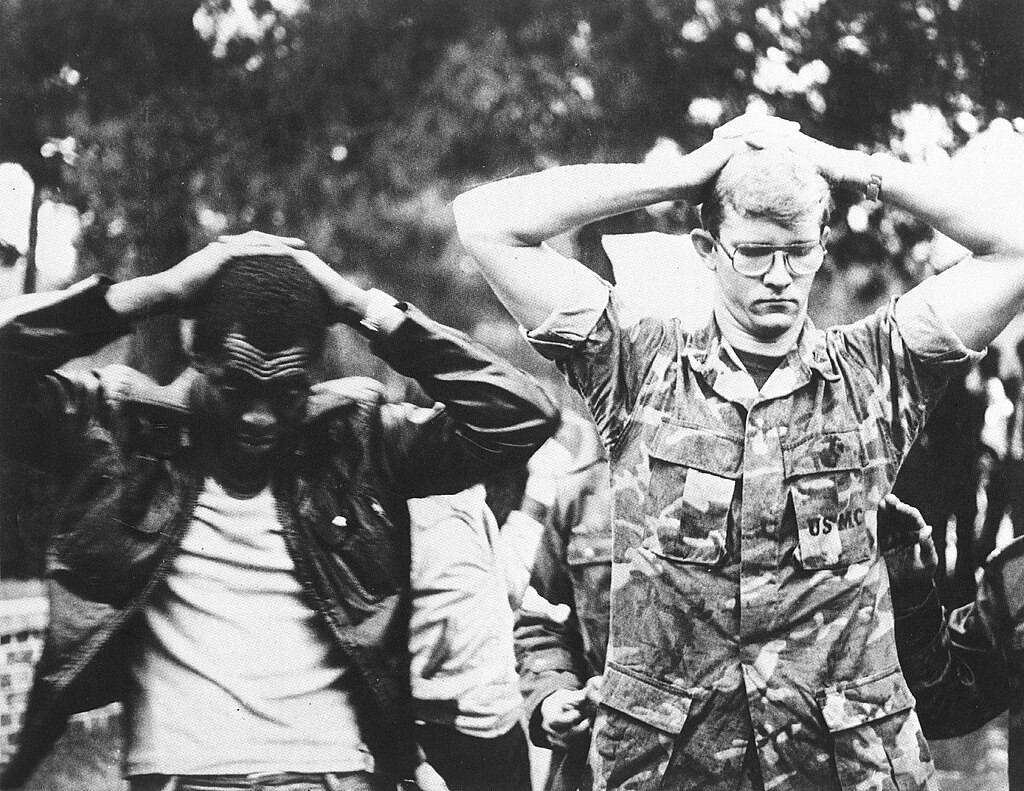
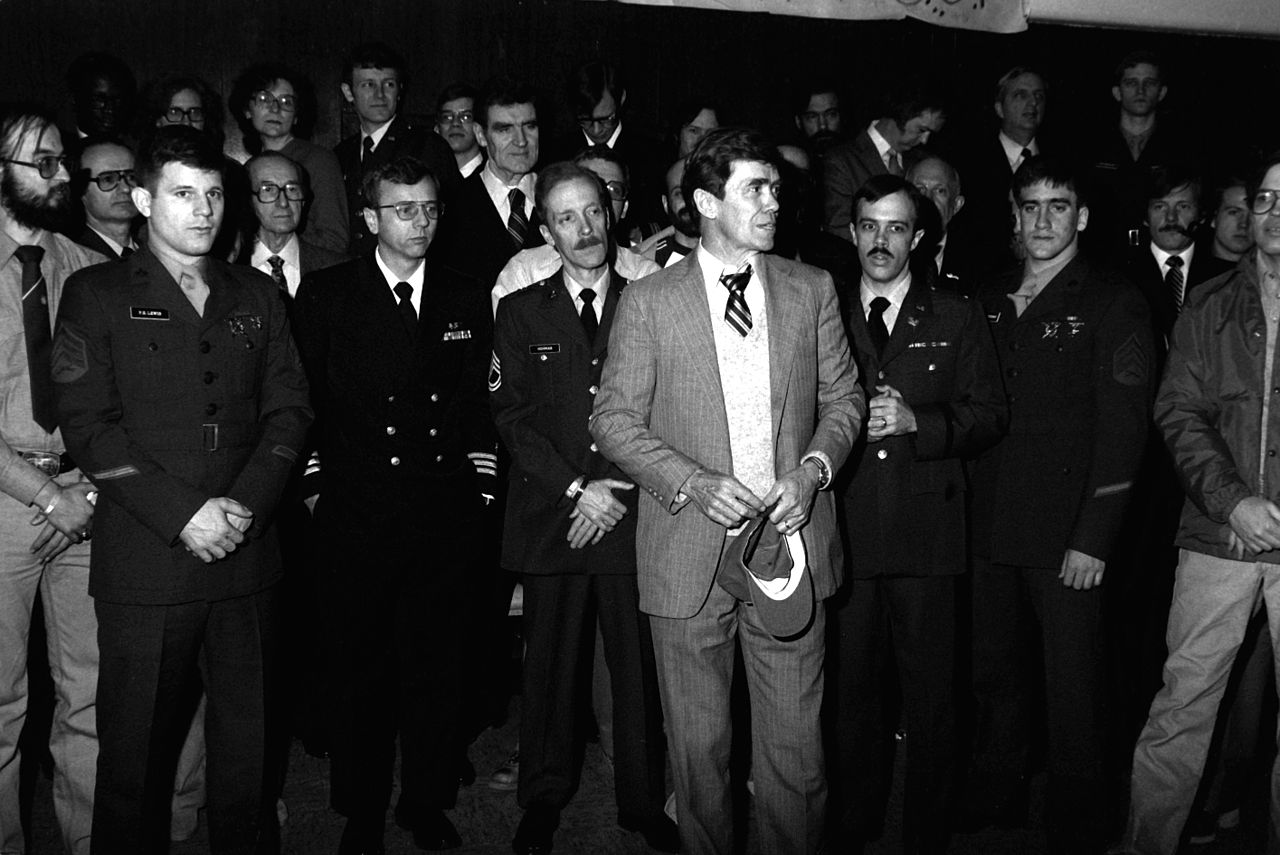 because of its closeness to the swearing in of President Reagan. I suppose we will never know for sure. Ten days after the release of the hostages a motorcycle parade takes place in New York City’s Broadway. Whatever the case may be, and no matter what kind of celebration was held in their honor, the lives of those hostages were forever changed. You can’t lose 444 days of your life and stay the same. Too much was forever missing. Things they could never get back.
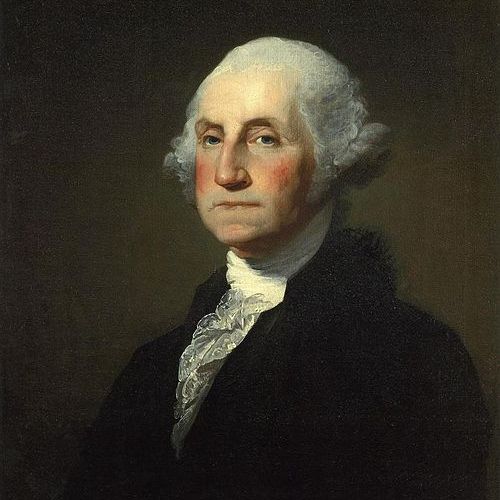 Long before James Madison became our fourth President of the United States, he served in a number of other positions. Early on, Madison emerged as an important leader in the House of Representatives and was a close adviser to President George Washington. While many of the early leaders of our nation understood and were prepared to fight for our freedom, they weren’t necessarily eloquent speakers or writers, but then again, many politicians today also have speech writers. I guess each felt the need to work on the important things, and delegate the rest. Since James Madison was well-known as an excellent writer, President Washington asked him to write a letter to Congress for him expressing that he was excited to work with them. Washington wasn’t the greatest wordsmith, and Madison was an excellent writer, so he had Madison do the job.
James Madison was excited to be a part of this first administration and wanted to give it his very best effort. So, in one of his first official actions under President George Washington, Madison wrote a beautiful letter to Congress. Congress was very impressed with the “letter from President Washington” and wanted to impress him with a letter of their own. So, naturally, they chose the best qualified person to write a response to President Washington…you guessed it, James Madison. So, Madison wrote a response to the original letter, that he wrote, saying that Congress was also very excited to be working with the president.
Under normal circumstances, you would expect that the two letters would be the end of the matter, and the new administration would proceed to get down to business. You would be wrong. President Washington decided to send a response to the response, and to make matters even more ludicrous, Congress sent a response to 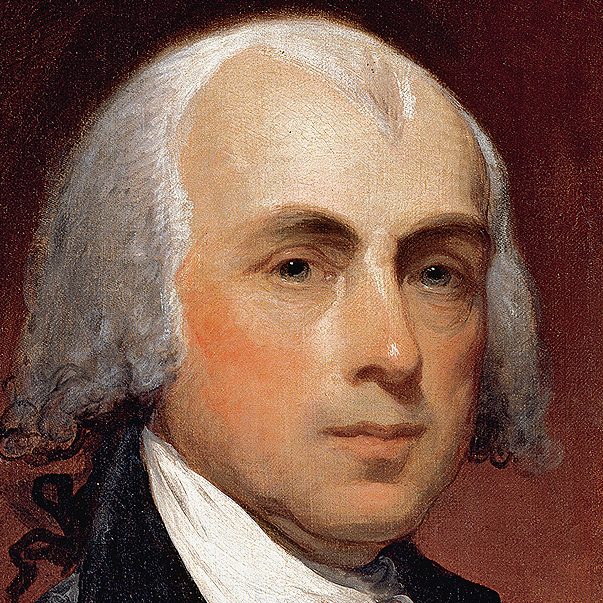 that response as well. As it turns out, and of course, Madison wrote those other letters too. So, all in all, Madison had a whole little conversation with himself by mail in the form of four separate letters. Of course, he still represented the president and congress, but it’s quite likely that no one actually read the letters before they were sent, or at least didn’t really read them carefully…not until they received them anyway. Nevertheless, James Madison wanted to do the very best job he could for both President Washington and for Congress. If he had not done an exceptional job, they would not ask for his help again, and his career could have been over. Somehow, I don’t think that was his real motive in writing the excellent letters. I think he wanted to be of good service to the president. Still in the end, Madison’s first official act for President Washington was to write four letters…to himself.
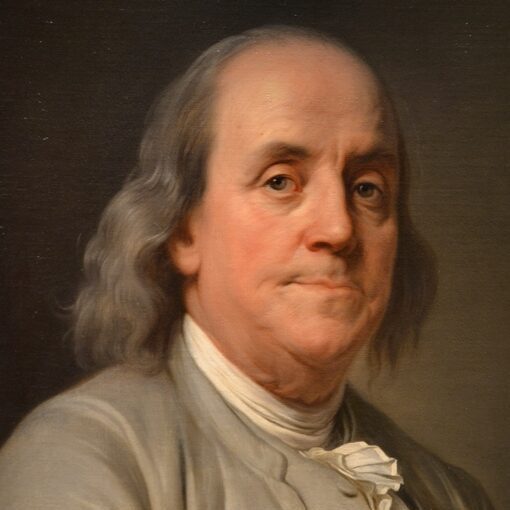
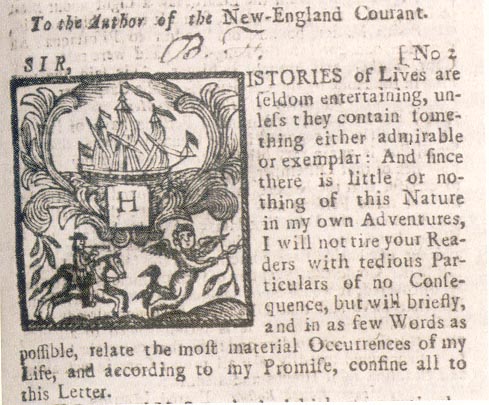 Out of the blue, in 1722, the readers of a paper published in Boston, called The Courant, were treated to and fascinated by letters that were sent in by a widow with an razor-sharp wit and a gift for sarcasm. Her name was Mrs Silence Dogood. Mrs Dogood had an unusual sense of humor. She liked to poke fun at such illustrious institutions such as Harvard. For that, many of her readers loved her and became avid followers. She wasn’t afraid to speak her mind, and she wasn’t afraid to call a spade a spade. She told it like it was, and she didn’t care what others thought of her.
So…just who was Mrs Dogood? Rumor had it that she was just an old widow woman who had been around long enough to have long lost any concern over what people thought of her. Maybe her many years of life had given her insight that no one else had. I remember reading Ann Lander’s column when I was a girl and a young married woman. Her advise always seemed so wise. I remember a number of articles from various columnists, and there again, my thought was, “How did they know so much?” I was sure they must have multiple degrees. Of course, while they might have had a degree or two, that did not make them any smarter than the next guy…and this type of writing was usually more about logic and common sense, that learned skill. So, who was Mrs Silence Dogood? That is the question of the day.
The answer to that question will most likely shock you. The reality is that Mrs Silence Dogood was the pen name used by Benjamin Franklin. Now, while Benjamin Franklin was a very intelligent man, as we all know. the fact remains that at the time he was writing under the pen name of Mrs Silence Dogood, Franklin was a boy of just 16 years. He was too young to be taken seriously or to have any possibility of getting his writings published, so he came up with an ingenious solution. His goal was to have his work published in the New-England Courant…a newspaper founded and published by his brother James Franklin. He took this goal seriously, especially after he was denied several times when he tried to publish letters under his own name in the Courant. Mrs Silence Dogood wrote 14 letters, which were first printed in 1722, and can be read here.
At the time of the printing of those letters, Franklin worked as an apprentice in his older brother’s printing shop in Boston. Franklin was a boy who had yet to get something he wrote published, so at 16, and desperate to finally receive the respect and recognition he felt he justly deserved. His idea was to create the persona of a 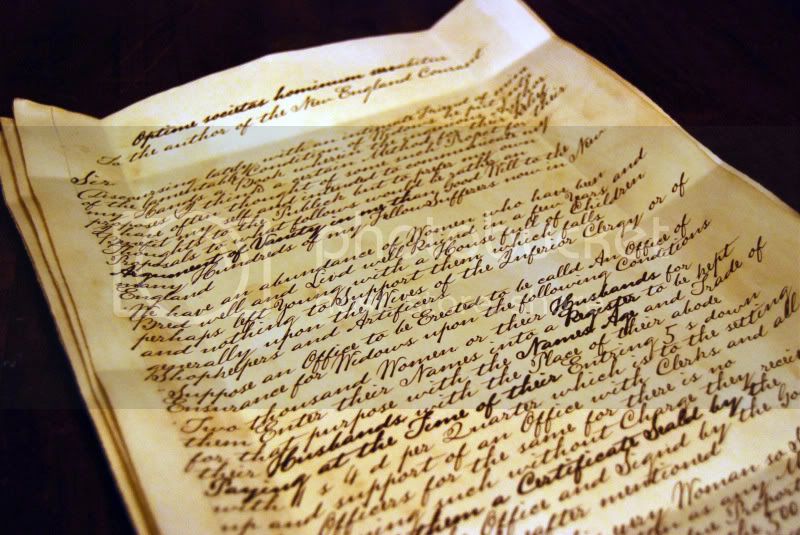
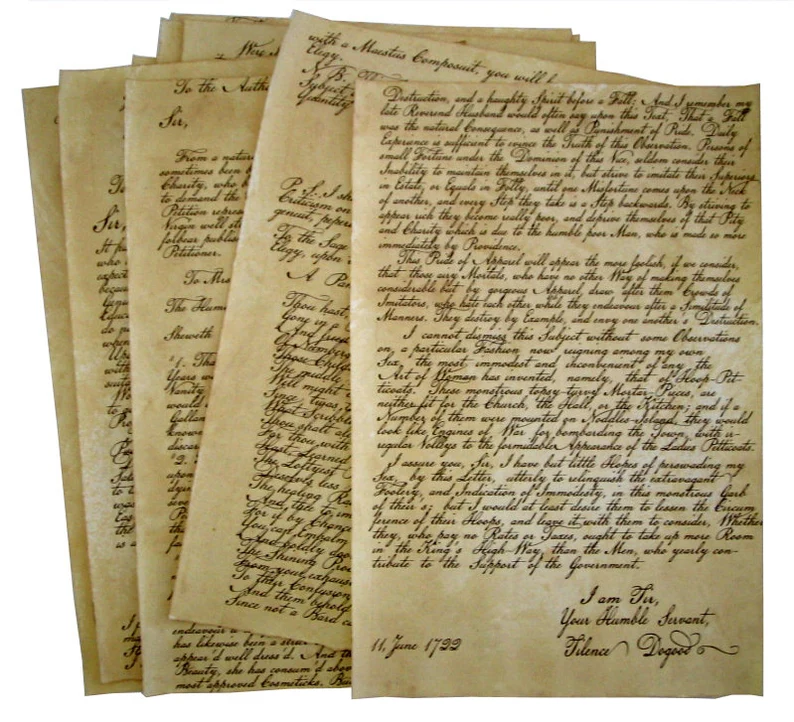 middle-aged widow named Silence Dogood. Once every two weeks, Franklin left a letter under the door of his brother’s printing shop. A total of 14 letters were sent. For months no one knew the identity of Mrs Dogood, but everyone was completely enthralled. Those letters were the talk of the town…even after they found out they were written by a 16-year-old Benjamin Franklin.
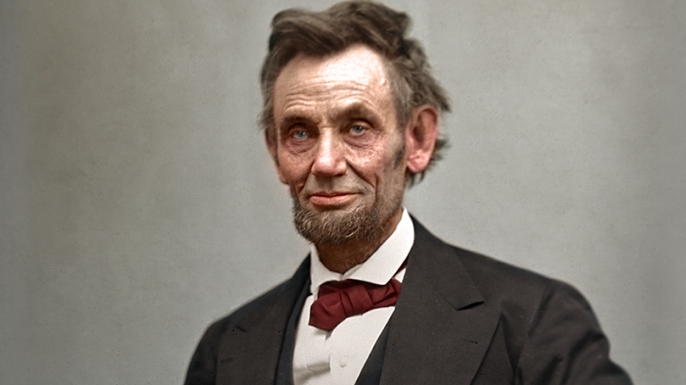 Abraham Lincoln was a great president, one of the greatest, but while the presidency defined his life in our minds, it was only a small part of the sum total of his life. His presidency ran from 1861 to his assassination on April 14, 1865, and subsequent death on April 15, 1865. Nevertheless, Abraham Lincoln was an amazing president and brought this country out of a dark time in our history.
Lincoln was a self-educated man, and he tried a number of occupations. One of them was bartending. It’s strange to think of President Lincoln as a licensed bartender. It’s not that there is anything wrong with bartending, and in fact, many American historical figures were involved in the alcohol industry. George Washington owned the largest whiskey distillery according to Mount Vernon’s official website, and according to Monticello’s website, Thomas Jefferson was also fascinated with beer brewing. Even Sam Adams, who was not a brewer, was involved in the industry, in that he made malt for the breweries. For his part, Lincoln, who would become the 16th president, opened up a bar called “Berry and Lincoln” with his friend William F Berry in New Salem, Illinois in 1833.
When Lincoln came home from serving in the Black Hawk War, which was the war between the United States and Native Americans, he didn’t really know what he wanted to do with the rest of his life. He thought about becoming a blacksmith, but then he reconnected with William Berry, who had been in his militia group. The two men hit it off, and eventually decided to open a general store in New Salem, Illinois. The store was called the Berry-Lincoln Grocery, and maybe it would have been better if this was as far as things went. At that time, stores were allowed to sell larger quantities of alcohol for drinking off-site. However, if they wanted their customers to be able to drink inside the sore, they would need to purchase a license. They were granted a tavern license which cost $7 in those days. Berry took charge of getting the license. They sold a variety of brandy flavors, including apple brandy, peach brandy, and even French brandy, among others. They also sold wine, rum, and two kinds of gin.
Lincoln wasn’t much interested in tending bar. He was more focused on serving as postmaster. So, it was decided that Barry would run the bar part of the store and Lincoln would run the store’s post office. For a time, the Berry-Lincoln Grocery did fine, but then things began to change. It turned out Berry was an alcoholic who took advantage of the store’s license to sell drinks. It gave him the ability to drink while working, and 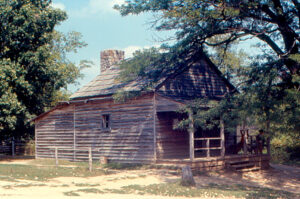 sometimes he was too drunk to function. So, Lincoln took more and more responsibility. Unfortunately, the whole situation led to the partners, taking on more debt. Eventually, Lincoln was done with the whole thing, and he sold his interest in the store to Berry in 1833. Just two years later, before Lincoln could be completely freed of the place, Berry died, leaving Lincoln to inherit the business’s debts. It was an awful situation, which was only resolved when Lincoln was elected to Congress in 1847, giving him enough of an income to clear the debts. Having had quite enough of the bartending/store owning industry, Lincoln became a lawyer and eventually a politician, which led to the great president we have all studied about, as well, of course, as his assassination.
When I first heard about the bizarre phenomenon found under the home of Benjamin Franklin, I thought of a few possibilities. The remains, found in 1998, consisted of 1,200 bones are believed to be from more than 15 human bodies found in the basement of Ben Franklin’s house. Six of the bodies were children. My first thought was, “Please tell me that this is some Indian burial site, or that there is some logical explanation as to why there would be bodies buried in this hero Founding Father’s home.” I have always liked Ben Franklin. I found his “antics” to be so interesting. To say the least, he was a bit strange in his experimentations, and that was enough to make me wonder (and hope it wasn’t so) if Ben Franklin could possibly have some horrid alter ego. He wouldn’t be the first scientist to go off the deep end to experiment on human bodies, but then again, there certainly are people today that have chosen to donate their bodies to science, so why couldn’t that be the case back then. I prayed that was the case.
At this point, many people would immediately assume that Ben Franklin was some kind of closet killer, who tortured and murdered his victims. It would be thought that the world had been so naive, that we lived in the dark for years, but before you go crafting a murder mystery about him, please be aware that it was revealed that the bodies were used in the study of human anatomy. So, it actually was bodies donated for scientific 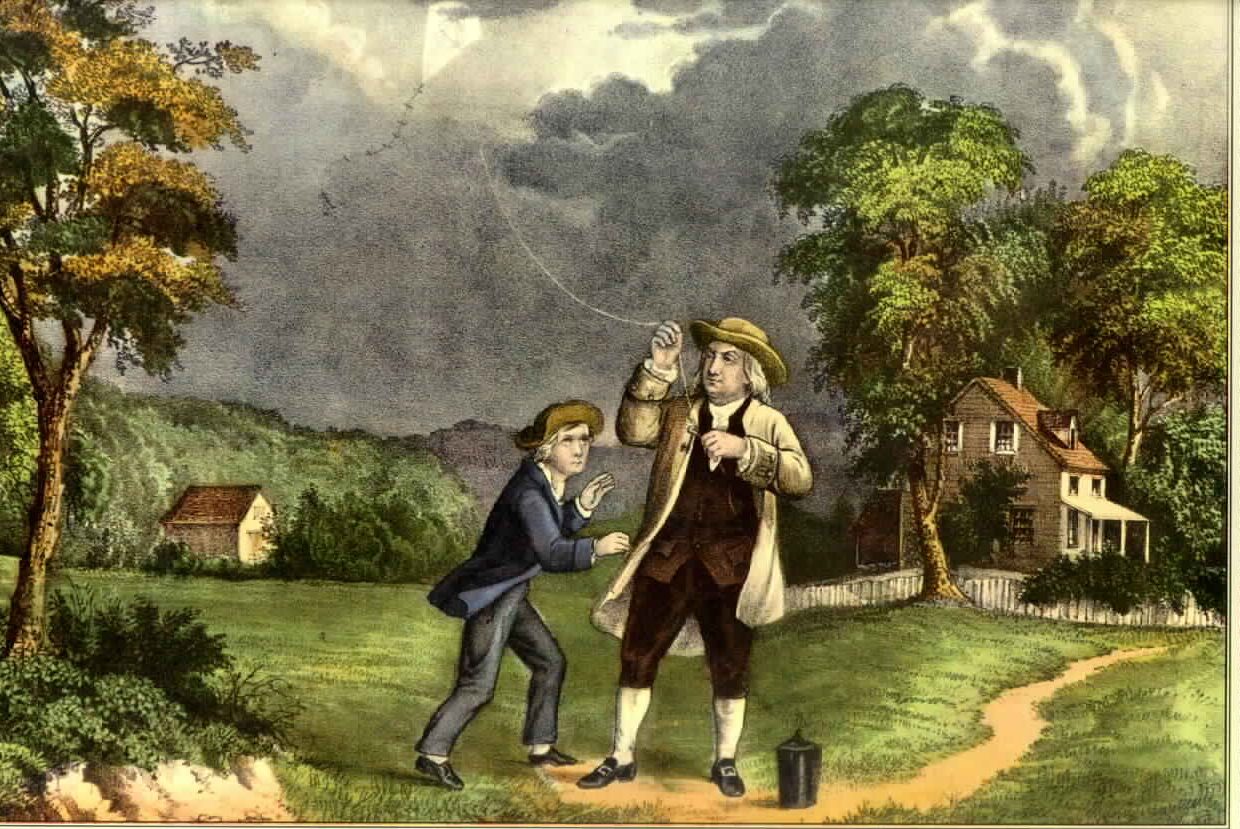 research. I certainly didn’t know that they did that sort of thing back then, but it seems that they did.
The house, located in London, England was undergoing some conservation work in 1998, when the bones were discovered. Some of the bodies were dismembered, or had trepanned skulls, which is skulls with holes drilled through them. Ben Franklin had lived home in London for nearly twenty years leading up to the signing of the Declaration of Independence. It was more than 200 years later, when the conservation work uncovered the 15 bodies in the basement, buried in a secret, windowless room beneath the garden. While on could imagine horrible things, “The most plausible explanation is not mass murder, but an anatomy school run by Benjamin Franklin’s young friend and protege, William Hewson.” So, it would seem that Ben Franklin either loaned the home to Hewson (a surgeon), stored the bodies for Hewson, or allowed Hewson to do his scientific experiments in the room in the Franklin house. Whatever the case may be, it is apparently well enough documented that the authorities were satisfied that Ben Franklin wasn’t personally involved.
One such speculation was that “Anatomy was still in its infancy, but the day’s social and ethical mores frowned upon it. … A steady supply of human bodies was hard to come by legally, so Hewson, Hunter, and the field’s other pioneers had to turn to grave robbing—either paying professional ‘resurrection men’ to procure cadavers 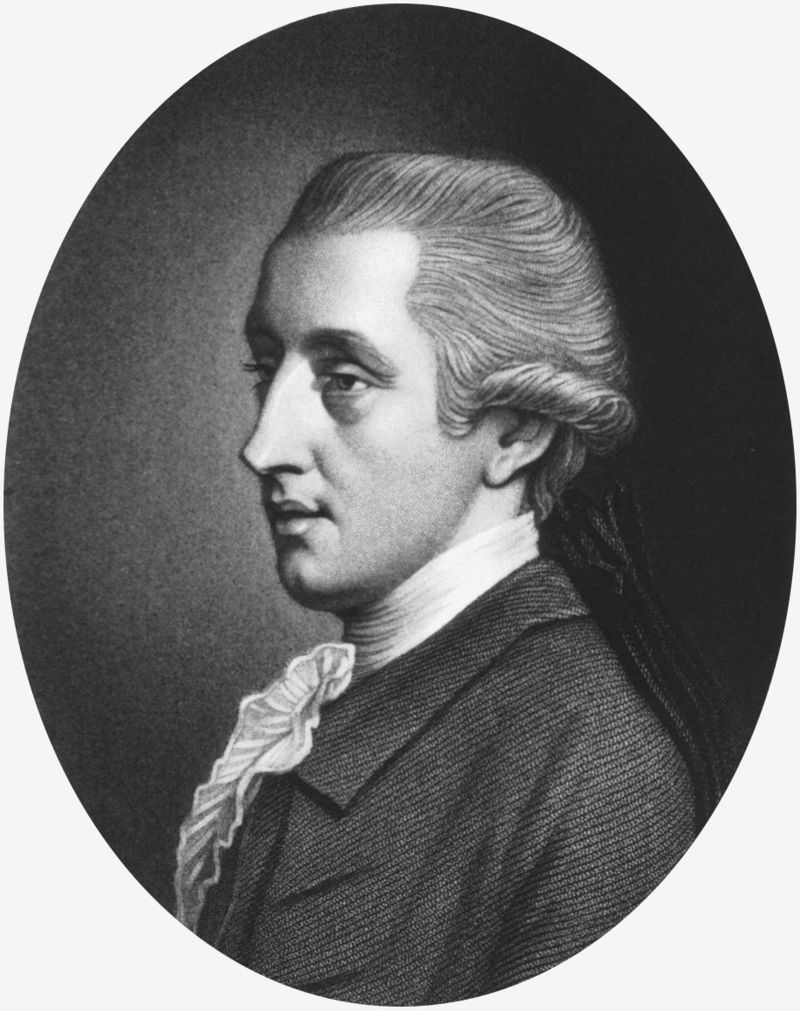 or digging them up themselves—to get their hands on specimens. Researchers think that 36 Craven was an irresistible spot for Hewson to establish his own anatomy lab. The tenant was a trusted friend, the landlady was his mother-in-law, and he was flanked by convenient sources for corpses. Bodies could be smuggled from graveyards and delivered to the wharf at one end of the street or snatched from the gallows at the other end. When he was done with them, Hewson simply buried whatever was left of the bodies in the basement, rather than sneak them out for disposal elsewhere and risk getting caught and prosecuted for dissection and grave robbing.” Some people speculate that Ben Franklin knew about the goings on, but was not personally involved, still, they thought he might have gone to the lab a few times to check out the proceedings. I hate to think that he knew anything about it, and I would prefer to think that the study of anatomy was done in his absence, but I suppose that our modern-day anatomy studies and autopsies were probably pioneered in a basement somewhere.
 Politics can be a touchy subject. Many arguments have come from political disagreements, and in fact, a number of actual fights and even wars have been fought over political disagreements. The Civil War was one sch war fought over political views. During that time there were also a number of private disputes as well. Sumner Pinkham was in volved on one of those disputes. Sumner Pinkham was born in 1820 in the state of Maine and was raised in Wisconsin. Very little, if anything, is known about his early life. He married Laurinda Maria Atwood in Nebraska on November 4, 1842. In 1849, Pinkham joined the California gold rush and then spent time in Oregon before making his way to the booming gold rush camp of Idaho City in 1862. Pinkham was a big man…powerfully built, who stood six feet two inches tall and had a barrel chest. He was also prematurely gray, making him look older than he really was.
Pinkham was a conservative Republican, a Unionist, and an abolitionist, which put him on the opposite side of the majority of Boise Basin mining camps political views, which were predominantly Democrat. When Pinkham arrived in the Idaho City area, Idaho was still a part of Washington Territory, and the Boise Basin was located in Idaho County, of which Florence was the county seat. Florence was located a way away from the new mining basin, so the Washington Legislature established Boise County on January 29, 1863.
After being in the area for a while, and becoming known for his political views, the Governor of Washington was assigning commissioners and officers to the newly established county, and Pinkham was one of them, assigned to serve as the County Sheriff. On March 4, 1863, Congress created Idaho Territory. At that time Boise County exceeded the other counties in both area and in population. Those in office in Boise County at the time, including Pinkham, retained their positions until the territorial government could be officially organized. Pinkham appointed Orlando “Rube” Robbins, who shared his political opinions, as his deputy in August 1863. Robbins would later make himself known as one of Idaho’s greatest lawmen.
By this time, the Civil War was raging back East, and the area miners began to choose sides, around the Union and Confederate causes. This, dueled with whiskey, caused flair-ups between North and South sympathizers, bring with it fist fights, knife fights, and sometimes gun battles as they used force to show their opinions. That kept both Pinkham and his deputy, Rube Robbins, busy breaking up fights and locking up drunken loudmouths as they threatened to fight it out…to the death. The area being predominately Democrat often placed Pinkham at odds with his constituents due to his staunch Unionist views, Republican politics, and tough law enforcement. His list of enemies grew. Nevertheless, both Pinkham’s enemies and his most loyal friends knew that he was a man they shouldn’t mess with when he undertook to enforce the law, which he did with an iron hand.
His greatest enemy was a Southern gunfighter named Ferdinand “Ferd” Patterson. On one occasion, while Patterson was partying with some of his friends in Idaho City, they took unlawful possession of a brewery in Idaho City. Sheriff Pinkham was called by the owner to remove the rowdy group. When Pinkham entered the brewery, he was met with violent resistance. Pinkham and Patterson immediately hated each other. Patterson was Southerner who was crooked by nature, and Pinkham was a Northerner who tended to be self-righteous. In the end, Pinkham was successful, and Patterson was arrested. When Pinkham lost his October 1864 for re-election as Boise County Sheriff, in a bitter contest between the Democratic successionists and Republican candidates. Pinkham was defeated by A O Bowen by a comfortable majority, and Patterson celebrated, as the last of the ballots were being counted. When Patterson encountered his old nemesis, he began rubbing it in. Pinkham, who was in a rage, swung at Patterson, hitting him in the jaw and throwing the gambler off the street and into the gutter. After that, Pinkham walked away. Everyone expected Patterson to retaliate, but he let it go…for then. Pinkham left Idaho City, following the lost election, heading to Illinois to visit his dying mother. When he returned in 1865, everyone figured they would have it out, but it didn’t happen then either.
After the Civil War ended, Pinkham held a huge Fourth of July party. The crowds were mostly festive, with fireworks blazing and booze abundant. The celebration included a brass band, speeches, patriotic songs, a picnic, and a parade with Pinkham leading the way through town. For the victorious Yankees, it was a proud day. But, for the sullen Confederate sympathizers…not so much. To make matters worse, the Yankee’s heckled the “Blue Bellies” throughout the day. Patterson was furious as he watched Pinkham leading the parade through town. Pinkham singing, “Oh, we’ll hang Jeff Davis to a sour apple tree!” was the last straw. Patterson yelled out to the ex-sheriff that if “he didn’t shut his mouth, he’d shut it for him.” Pinkham invited him to try, and he did. A brief fist fight between the two men resulted in the flag falling into the dust of the street. Some witnesses swore they saw Patterson spit on it, and others attested they heard Pinkham swear he would kill Patterson for that, but nothing more came of it at that time. Several weeks later, on Sunday, July 23rd, Pinkham took a hired carriage from Idaho City to the Warm Springs Resort, which was about two miles west of town. Upon his arrival, Pinkham joined a number of his Unionist friends in the saloon, where they were heard singing patriotic and anti-Confederate songs.
Sometime later, Patterson entered the resort while Pinkham was paying his bill. Initially, Patterson ignored Pinkham, but by the time the ex-sheriff exited the resort, Patterson was outside waiting for him. Patterson said the word “draw” and then taunted Pinkham by calling him an “Abolitionist son-of-a-b***h.” Who drew first is in dispute, but in the end, Pinkham was dead. Patterson quickly fled but was immediately followed by several lawmen. Rube Robbins was the first to catch up to him, about 14 miles from Idaho City. Patterson surrendered to Robbins, who turned the killer over to Sheriff Bowen, who was next on the scene. Bowen and his men took over and escorted Patterson back to Idaho City.
A mob wanted to lynch him, and maybe that would have been justice, because in the “sham” trial held in a predominately Democrat area, Patterson was acquitted, and with that, justice for Pinkham would never be served. Ferd Patterson was tried for Pinkman’s murder at the beginning of November 1865. In the six-day trial, defense attorney Frank Ganahl claimed his client acted in self-defense, arguing that Pinkham was lying in wait 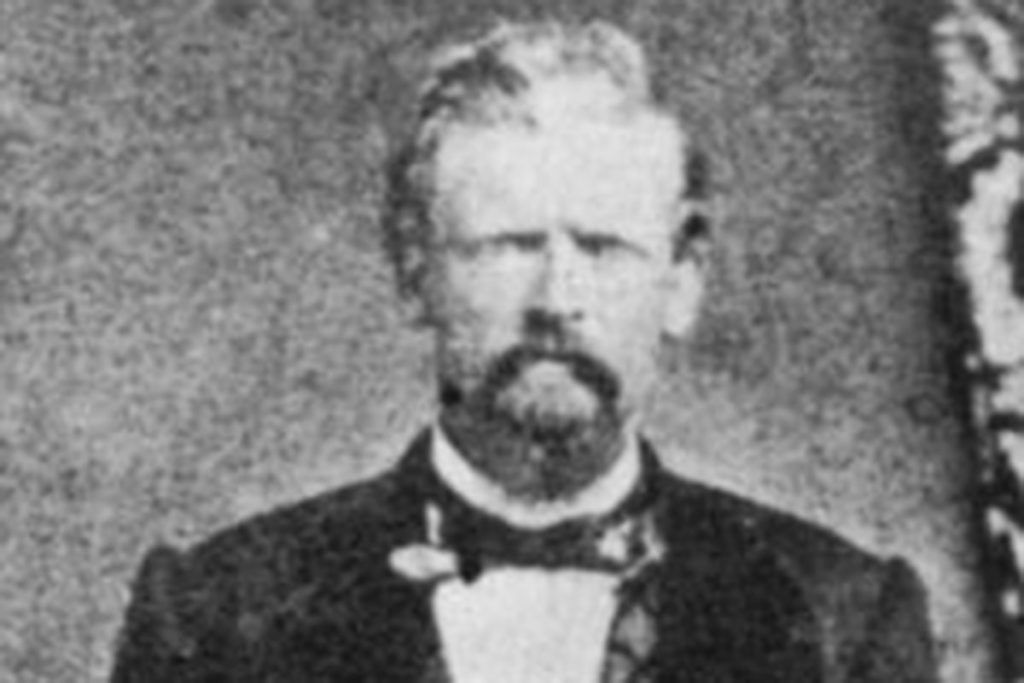 for him. Alternatively, Pinkham’s friends testified that he tried to avoid a showdown and that Patterson came to Warm Springs with the explicit purpose of murdering Pinkham. It took only an hour and a half for the jury to acquit Patterson. Pinkham’s funeral was the largest and most impressive funeral ever seen in the mining camp. It was reported that over 1,500 mourners followed his hearse to the graveyard. Meanwhile, knowing he was in extreme danger, Patterson quickly fled Idaho City after his acquittal. He was killed in Walla Walla, Washington, the next year, by Thomas Donahue, an area policeman, in was thought by many to be an assassination. Donahue was charged with the murder of Patterson, but escaped from jail while awaiting trial. There apparently was little interest in tracking him down. He disappeared never to be heard from again.
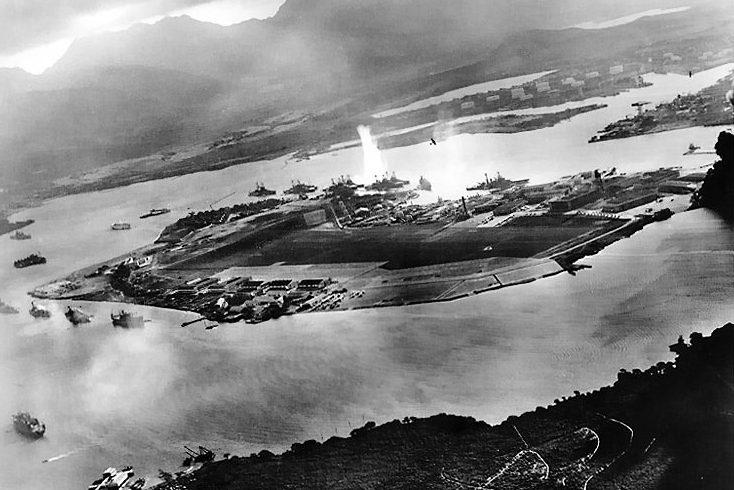
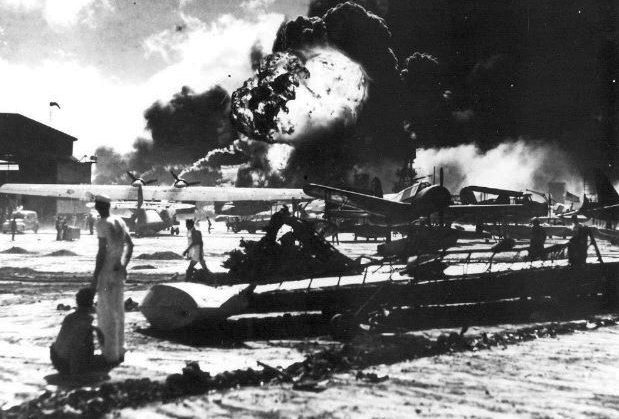 There are some national events that stay in our thoughts and hearts forever. The Pearl Harbor is one of those events. The attack on Pearl Harbor was so destructive and so unexpected that it shocked everyone…well, most everyone anyway. President Franklin D Roosevelt knew that Japan would likely attack, but thought it would be in the western Pacific Ocean, especially the Philippians. Pearl Harbor was considered an unlikely target. Roosevelt wanted to enter the war, but he wanted to attack Germany, whom he considered to be the bigger threat. In fact, he had ordered the attack on any U-Boats found in the west side of the Atlantic. So, technically the US was already in the war…most people just didn’t know that. Still, the attack on Pearl Harbor was horrific and the United States had to retaliate.
The attack on Pearl Harbor took so many people by surprise. It was a Sunday morning, and many of the military personnel were off base attending church services. The Japanese knew that the ships, planes, and the base in general would be seriously understaffed at the time of the attack. Of course, on the flip side, the fact that so many of the military personnel were away from the base at the time of the attack, meant that the base was able to get back up and running quickly and when we did enter the war, the Japanese were surprised about the attacks coming back at them. Of course, as we all know, the Allies went on to win the war against the Axis nation, including Germany and Japan. It’s been said that people shouldn’t wake the sleeping giant, and that is a wise statement. The Japanese awakened the United States to the fact that appeasing your enemies will not prevent an attack. It takes a show of military might to inform our enemies that it is wise to back away and let the sleeping giants lie.
Of course, the victory that was won following the attack of Pearl Harbor and the US entrance into World War II, came at a high price. A total of 2,403 people (both civilians and soldiers), not to mention ships, airplanes, and 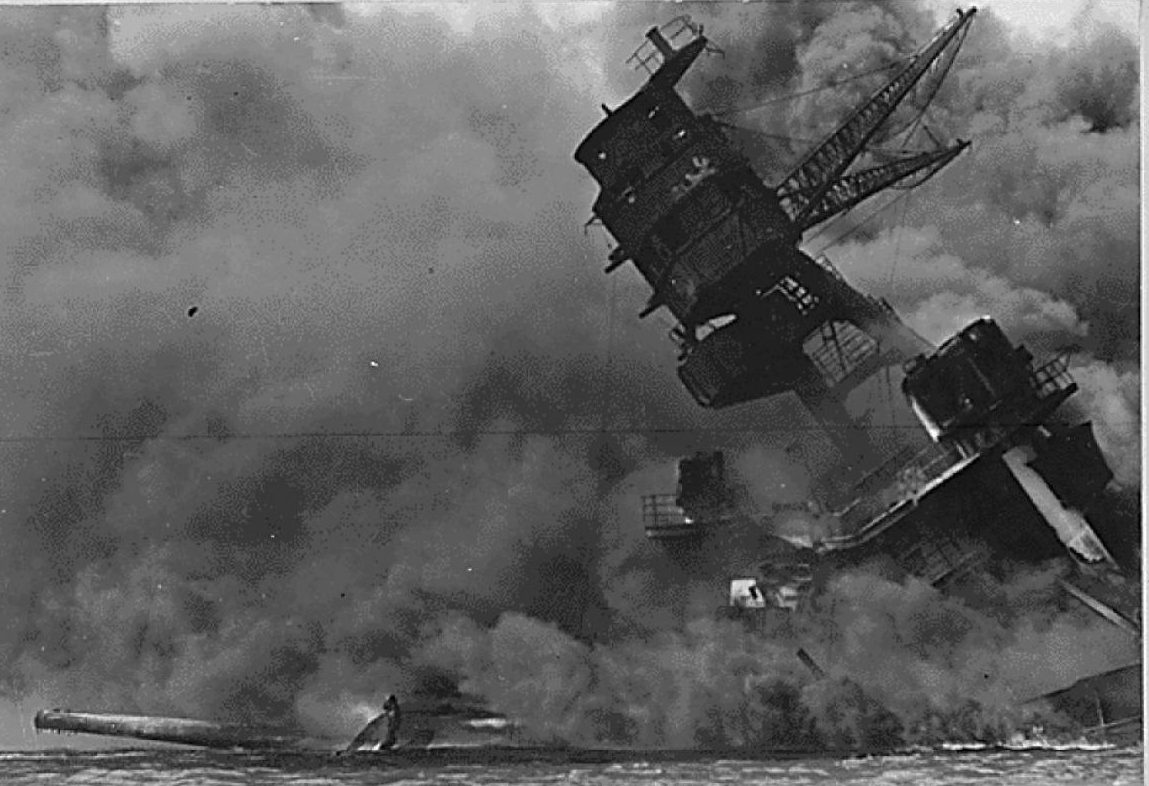
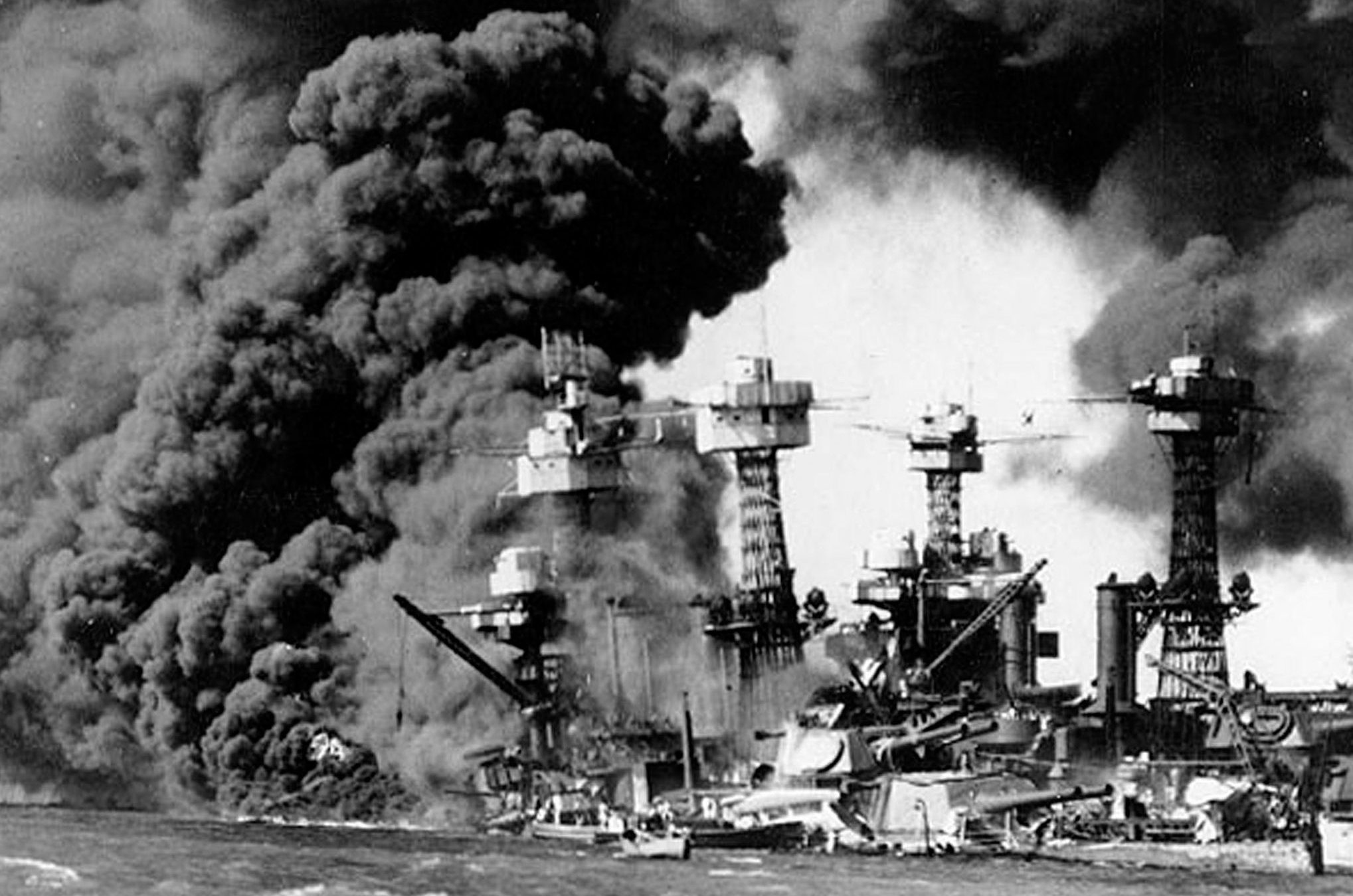 other military equipment. After the attack, the people of the United States were…angry!! We quickly geared up and the war was on for the United States. Our delay could never bring back the people we lost, but we would certainly avenge their loss. Today we remember those we lost, and those who went out to take up the fight to protect our country from such a horrendous attack.
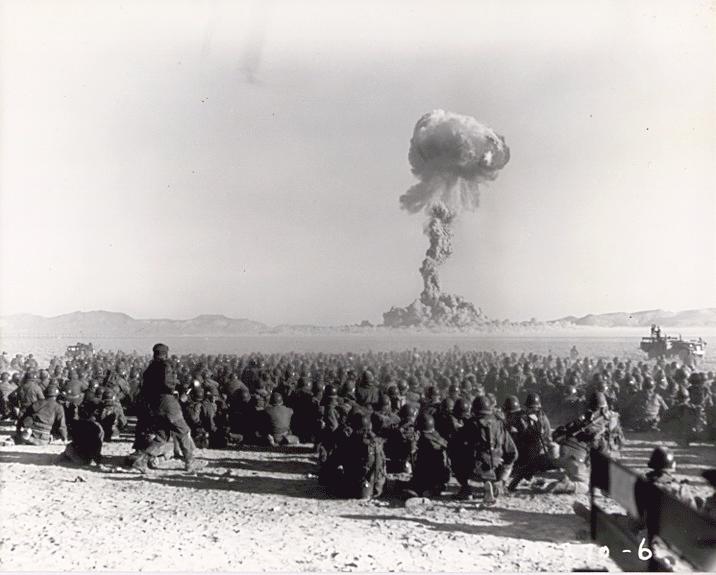
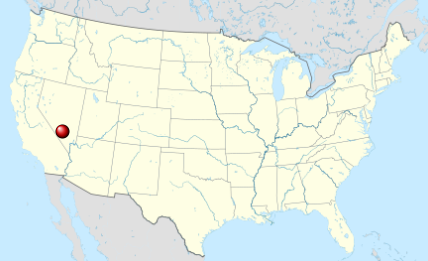 Our government has been known, in its history, to do some things that really were underhanded, and in some cases horrific. The “need” for nuclear bombs naturally facilitated the need for nuclear testing. I think everyone knows that would had to have happened, but on November 1, 1951, the US Army conducted nuclear tests in the Nevada desert that included a “diabolical exercise in which 6500 US Army troops were exposed to the effects of a nearby nuclear detonation and its associated radiation.” When I read that, I was furious. They knew what they were doing, and they did it as an experiment…just to see what would happen to those poor men.
It was called Operation Buster–Jangle. The US Army conducted a series of 7 nuclear tests, that included the November 1st test. In that involuntary one test, the 6500 troops, were dug in foxholes and trenches only 6 miles from an air burst nuclear bomb of 21 kilotons yield. That is about the size of the Nagasaki bomb!! After the soldiers felt the hot nuclear wind blast over them, the wind deposited desert dust in choking clouds upon the men. Then, the soldiers were ordered to get up and march across the blast site to within 900 meters (a little over ½ a mile) of the nuclear “ground zero.” That is incredibly close, and those men were exposed.
The damage done to those men was not well documented, but the US Government later passed the 1990 Radiation Exposure Compensation Act (RECA) to compensate the military veterans exposed to nuclear testing in the 1950’s. The passing of that act is implied acknowledgment of the responsibility of the US government in long term health problems experienced by those troops…without actually placing the blame, and therefore opening the government up to future lawsuits. Basically, the men, were they still alive, or their families, if not, 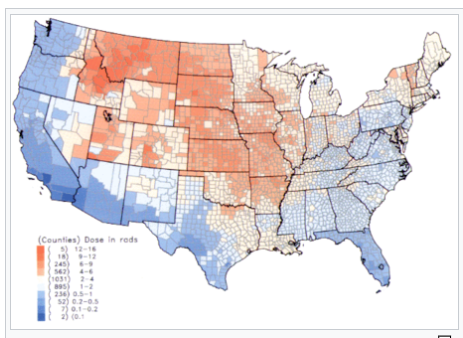
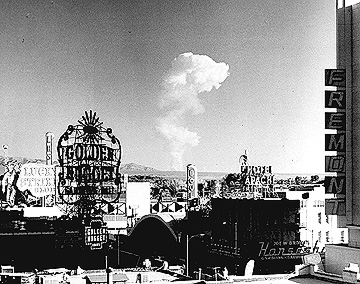 could theoretically be compensated for their losses. Of course, as many of us have seen with these kinds of cases, the process is very slow, the burden of proof for the men trying to receive compensation is heavy, and the final payout is usually quite low. RECA has awarded over $2.4 billion in benefits to more than 37,000 claimants since its inception in 1990. Still, that’s a small price to pay for the destruction of so many lives.

