Monthly Archives: September 2025
 A little-known practice, in modern times anyway, was the practice of taking babies outside, even in freezing temperatures, to take their naps. It was thought that the practice would boost their immune systems. Of course, I have never heard of such a practice in the United States, or for that matter, in any other country, but it was a common thing in the Soviet Union (now Russia). Such an odd practice it was, but over the centuries, there have been many odd practices in the name of medicine. Things like using leeches to “bleed” a person used to be common. Now we know that “bleeding” a person only makes them weaker. Another odd practice was bathing a feverish child it a hot bath. It was thought that by “sweating” the person, the fever would break. So many of the people treated in this archaic way died. Not from their disease, but from the “cure” that was used.
Russia receives heavy snowfall during the winter months and even remains cold even in the warmer seasons due to its proximity to the Arctic Circle. With that, you might assume that people would stay indoors all the time due to the frigid climate. However, during the Soviet era, particularly in the 1950s and 1970s, there was a common practice of letting small children sleep outside for fresh air and sunlight. This tradition continued even in winter…the children actually napped outdoors in the snow. As strange as it sounds, this was once a widespread custom in Soviet Russia. Most of us can’t imagine doing that, and our doctors would probably pass out in shock. Family services would likely take the kids away from such parents, but not in the Soviet Union. It was considered a healthy practice!!
Although it might seem strange, this practice actually stemmed from the opposite extreme. The Soviet  emphasis on fresh air in kindergarten routines for kids was influenced by how the Tsars were raised. During the Romanov era, the early Romanovs seldom left their quarters to enjoy fresh air or sunlight, resulting in weak immune systems and poor health throughout their lives. Observing this, civilians recognized that a lack of sunlight, activity, and fresh air contributed to declining health in both children and adults. By the 1930s, as Soviets battled a tuberculosis epidemic with treatments and vaccines, it became evident that everyday hygiene and lifestyle changes were crucial in overcoming the disease. You can’t just treat disease. You have to live a healthy lifestyle too.
The Soviet people understood the importance of raising a generation with strong lungs and healthy respiratory systems to prevent the return of epidemics. So, to achieve this, they introduced practices that exposed children to fresh air and outdoor activities, starting from kindergarten. I suppose that part makes sense, but kids were often left outside to strengthen their immune systems, and those who grew up in the 1950s and 1960s recall sleeping on open verandas, even during winter. Beyond sleeping outdoors, children were encouraged to play outside regularly, which makes sense. Schools also ensured kindergarten rooms were aired out at least twice a day, providing toddlers with fresh air, sunlight, and vitamin D, which helped build immunity against airborne pathogens. Additionally, Soviet children were dressed warmly but not overly protected from the cold, which helped them develop a natural tolerance to low temperatures.

These practices were thought to help children adapt to their natural surroundings and build immunity. As a result, kids wore winter coats only when temperatures dipped below 25 degrees Fahrenheit. It was common to take children outside for naps, even infants who couldn’t walk were placed in cots outdoors and wrapped in warm blankets. Verandas and semi-open rooms were often heated with firewood stoves to combat the cold. This tradition continued into the 1970s and 1980s, with many recalling being taken for walks in just underwear and even washed with freezing water from a hose. While the kids survived the harsh upbringing, I wonder if here is any proof that these practices actually built stronger immune systems. We will probably never know.
 September 29, 1954, might have started out as a normal game day, but it would end up as anything but normal. The game was being played was between the New York Giants and the Cleveland Indians. It was a special game in that it was Game 1 of the 1954 World Series at the Polo Grounds in Manhattan. By the eighth inning, the game was tied at 2-2. Vic Wertz of the Cleveland Indians crushed a deep fly ball to center field, looking like it was sure to drive in runs. Then…the “impossible” happened. New York Giants center fielder Willie Mays made an incredible over-the-shoulder catch while sprinting, and his quick throwback to the infield stopped a runner from advancing. Forever known as The Catch, the play was iconic. I’m sure that the Indians figured they were sure to win the game, but their hopes were dashed with that one catch. In the end, the Giants won the game 5–2 in extra innings and went on to claim the World Series. “The Catch” remains one of baseball’s greatest moments.
In the top of the 8th inning, with the score tied 2–2, the game was going along normally. Giants’ pitcher Sal  Maglie walked Indians leadoff hitter Larry Doby. Al Rosen followed with a single, putting runners on first and second. Giants’ manager Leo Durocher brought in left-handed reliever Don Liddle to face Cleveland’s left-handed batter Vic Wertz. Wertz worked the count to two balls and one strike before crushing Liddle’s fourth pitch about 420 feet to deep center field. In most ballparks, it would’ve been a home run, giving the Indians a 5–2 lead. But the Polo Grounds’ isn’t most ballparks. At Polo Grounds, the center field is the deepest in the league at 483 feet. That kept the ball in play just long enough. Willie Mays, playing shallow center, sprinted back and made an incredible over-the-shoulder catch near the warning track. After the catch, Mays spun and fired a throw to second base. Doby, who had run on contact, had to scramble back to tag up and couldn’t advance. Mays’ throw held Cleveland to runners on first and third with one out.
Right-hander Marv Grissom then replaced Liddle, who reportedly told coach Freddie Fitzsimmons, “Well, I got  my man.” Grissom walked pinch hitter Dale Mitchell to load the bases, struck out pinch hitter Dave Pope, and got catcher Jim Hegan to fly out, ending the inning without allowing any runs. That one play stopped the Indians from taking the lead. The game wasn’t over, but it might as well have been. In the bottom of the 10th inning, the Giants secured the win and went on to sweep the Series. “The Catch” is widely regarded as one of baseball’s greatest and most memorable plays due to its difficulty, its impact on the game, and the significance of the game itself. As for Willie Mays, he didn’t consider “The Catch” his best defensive play at all. I suppose it all happened so fast that he couldn’t even be positive how he had done it. In fact, many other factors could have been at play that day. In 2007, a physicist determined that if the temperature had been 77° F instead of 76° F, the ball would have traveled two inches farther, and “The Catch” might not have been made. Could one degree have really made that much difference. I guess we will never know for sure.

 It seemed like a possibility, I suppose. I mean there was a water passage across Panama, so maybe there could be one across North America too. Maybe, had it not been for the vast West to East expanse of the United States. Nevertheless, in 1542, they had no way of knowing how vast North America was. It was not like today, when we have mapping and satellite imaging. So, on September 28, 1542, the Spanish explorer Juan Rodriguez Cabrillo arrived in San Diego Bay while searching for the Strait of Anian, a mythical all-water route across North America.
Cabrillo wasn’t the first to search for a water passage across North America. He wouldn’t be the last either. The voyages of Columbus had Europeans dreaming of discovering a shorter trade route to the Orient. Unfortunately, Columbus hadn’t sailed to India when he came across North America, but rather he found an entirely new continent. Still, that fact didn’t stop explorers from trying to find an all-water route through the New World. Early 16th and 17th-century explorers like Cabrillo thought such a route might be the mythical Strait of Anian, a passage some sailors claimed connected the Pacific Ocean to the Gulf of Mexico (now Gulf of America).
In June 1542, Cabrillo set sail from the West Coast of Mexico, heading north to explore the rugged and intricate Pacific coastline. He frequently turned east to investigate inlets that seemed like they might lead to the elusive Strait of Anian. His trip wasn’t a total waste of time, because along the way, Cabrillo became the first European to chart numerous bays and inlets along the Pacific Coast. While San Diego Bay and the other inlets he explored didn’t lead to the legendary strait, Cabrillo managed to map many significant features of California’s coastline, although he missed discovering San Francisco Bay.
Although the Cabrillo mission failed, explorers persisted in their quest for the Strait of Anian and the Northwest Passage for many years, yet without success. Ironically, a route across the continent did exist, and in 1905, 
 Arctic explorer Roald Amundsen became the first to make an all-water crossing of North America. However, Amundsen’s frigid and perilous far-northern path was far from the shortcut to the east that Cabrillo and countless other explorers had envisioned and sacrificed their lives for over more than five centuries. It just wasn’t really feasible because of the sea ice that existed there for so much of the year. Shipping would be impossible in Winter.

 Our granddaughter, Athena Petersen became our granddaughter when she married our grandson, Josh Petersen. They are boy parents, and while they would have like to have a daughter, God had other plans for them, and they love each of their 3½ boys, with their 4th due in early March. Their boys adore their parents and keep them hopping with all their energy. As each new boy has arrived, Athena and Josh have fallen in love with their little sweeties, as have we. Their house is fille with the rough housing play that boys always bring, and yet there is a sweetness as the older boys try to help with the little ones. I can picture a future of forts in the back yard, water gun fights, wrestling, skinned knees, and little boys needing hugs…but then that has already started. I can also picture those big boys, picking on their outnumbered mom, right before they give her a big hug that melts her heart. Boys have a way of winning their mother’s heart.

 Athena came from a larger family, as I did, and we both know the comradery that can only come from being surrounded by many siblings. You just always know that your siblings are there for you, even as you are fighting with them. While they may fight with you, nobody else had better, because siblings will vehemently protect their fellow siblings. It is usually one of the perks of being in a big family. Athena was blessed with five siblings, Ray, Larissa, Jillian, Jacob, and Andrew, and she is very close with all of them. Of course, they all pick on each other, but that is all part of growing up with siblings, and she wouldn’t trade it for anything.
Athena and Josh are so perfect for each other. Theirs is a match made in Heaven, and they both keep God at the head of their union. It is a sweet thing to watch as their love for each other grows right along with their 
 love of God. Athena and Josh are strong, moral people who are raising their boys to be gentlemen, and that is a rarity in this day and age. The boys are young, but the way kids are raised will determine the kind of people they will be later. Athena and Josh are great parents, and their boys love them very much. They love getting the boys out to do things, like going to the park. Being a parent is a big responsibility and it’s a lot of work, and while it can be exhausting, it is also very rewarding. They are very blessed. Today is Athena’s birthday. Happy birthday Athena!! Have a great day!! We love you!!

 On September 5, 1972, eight members of the Palestinian militant group called Black September secretly entered the Olympic Village in Munich, West Germany. They were disguised as athletes. They broke into the Israeli Olympic team’s quarters, killing two members and taking nine others hostage. The group demanded the release of 234 Palestinian prisoners in Israel and two German terrorists held in West German custody. The attack shocked the world. The Olympics was supposed to be a time of friendly competition and comradery among the athletes. With the attack, athletes were no longer sure of their safety.
When the United States bid for the 1980 Winter Olympics, it made an agreement with the International Olympic Committee…the village near Lake Placid in upstate New York could be built with public funds, but only if the dormitories were later repurposed as inmate housing. The five cinderblock dorms featured 1,000 small, basic “sleeping rooms,” each with barred windows. Heavy steel doors had “peep” windows for guards to check on future inmates. The site was enclosed by two 11-foot electric perimeter fences—initially to keep terrorists out, and later to keep prisoners in. The idea seemed like a good one…in theory, but it was not well received.
Many athletes were frustrated by accommodations that resembled a future prison. “After four years of intense training, we cannot expect competitors to live in such terrible conditions,” remarked Gianfranco Cameli, a member of the Italian Olympic Committee. “The rooms clearly indicate their purpose… If two people stay inside with the door closed for privacy, they would feel imprisoned—stifled.” Protesters demonstrated during the Olympic torch relay, while an opposition group distributed posters depicting the torch held by a hand reaching out from behind prison bars. The plan for a future prison at the Olympic Village made the athletes feel like prisoners themselves, even if the reasoning was to ensure their safety. Beyond the dorms, six other buildings completed the complex, all repurposed for a new use. The athletes’ recreation center, which used to feature a game room, discotheque, and 350-seat theater, now serves as a prison chapel, chaplain’s office, psychology department, and commissary, according to the Bureau of Prisons. In retrospect, it probably wasn’t a good idea to make the rooms like cells, but it was approved.
On September 26, 1980, the Lake Placid Olympic Village reopened as a federal correctional facility, meeting a 
 Congressional mandate to repurpose the site after the games. The complex was originally designed with athlete security in mind following the 1972 Olympic terrorist attacks, the complex’s layout made it an ideal candidate for conversion into a prison. The transformation was completed, and it was a pretty good prison, but I doubt if the prisoners felt honored.

 My grandniece, Jolene Thompson is such a sweet girl. She officially joined our family when her daddy, Tim Thompson married my niece, Kellie Hadlock, but she was a part of our family long before that day. The first time we met Jolene, we loved Jolene. She is that kind of girl. She has a beautiful smile that lights up her whole face, and as strange as it may sound, I think she looks quite a bit like Kellie. They have many similar features, and similar personalities.
When Kellie sent me pictures of Jolene, my first thought was…Jolene is fearless!! Of course, I was referring to Jolene holding up a snake!! Kellie agreed, saying, “She is the bravest little girl!! She loves to fish, and she knows all the ins and outs of it! She baits my hook for me, and she does all the gross things I 
 don’t like to do!!” Kellie was never a serious hunter-fisher girl, but Tim and Jolene are slowly drawing Kellie into that world. I’m not sure she will ever bait a hook, but thankfully, Jolene can do that for her. Jolene is capable, and she takes Kellie’s hand and leads her into this new world that Kellie has fallen in love with.
Kellie says, “Jolene is the kindest and funniest kid, and she is every bit her father’s child!! Fearless!! She does all the things that I could never dream of doing like picking up snakes and finding bugs and all that, haha. Tim’s favorite thing is to tease her and pick on her, and she fires right back at him and doesn’t miss a beat!! She is always the first to ask if we need help with anything around the house, she is so sweet to everyone she comes in contact with. She is so good 
 with her younger cousins and siblings and loves to be the leader and take care of them.” Jolene is very capable, but she might be just a little bit shy too. Kellie tells me, “Once she got used to the idea of being in front of people for our wedding she was STOKED!! She loves to get dressed up and she loved that she got to pick out her own dress for the wedding and her hairstyle. She is the girliest outdoor girl in the world!! I am so thankful that God gave me her for a daughter!! She is so incredible, and I have loved every minute of watching her grow! We are so incredibly blessed to have our sweet Jolene!!” Still, Tim will say, “She loves her bibs when we’re doing boyish stuff!!” That may change later, but I’m sure she and her dad will always do the “boyish stuff” together. Today is Jolene’s 10th birthday. She’s in the double digits now!! Happy birthday Jolene!! Have a great day!! We love you!!
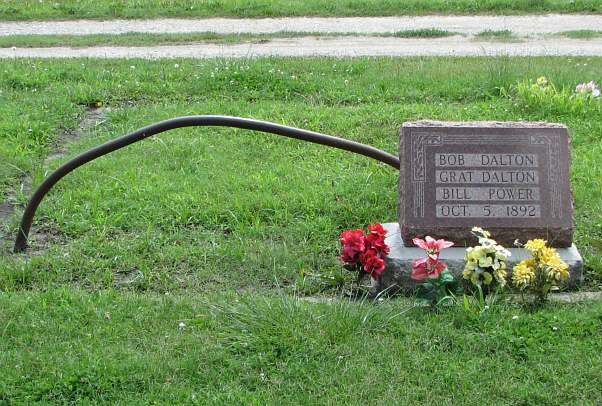 Whenever I see a cemetery, especially an old frontier type cemetery, I wonder if I know any of the people buried there, or if any of them might be my ancestors. It occurs to me that even if there were ancestors of mine in there, it would take more time than I would likely have at that moment, to seek them out. There have been times that I had prepared for a search of the cemetery, of course, but sometimes you just can’t be prepared. Sometimes that graveyard just appears where you least expect it…like the one I noticed, as my sisters and I were driving through a little town in Kansas. As we drove through the town of Coffeyville, Kansas, I noticed a little sign that said, “The Dalton Gang graves” and directions to Elmwood Cemetery. We didn’t go in. We had someplace to be, and I don’t think those graves mattered as much to my sisters as they did to me. I can’t say exactly why they seemed so important to me, except they were…history. The thought that those outlaws had been in that area, carrying out their crimes was…intriguing to me.
There are other cemeteries, of course. The ones you plan to go to, like the one in Deadwood, South Dakota…Mount Moriah Cemetery, where such notables as Wild Bill Hickok and Calamity Jane, as well as some we might  not know as well, like Seth Bullock (the first sheriff of Deadwood), Potato Creek Johnny (a local figure known for his colorful life), and Madam Dora DuFran (a local madam and socialite). While this cemetery is rather “touristy,” the graves are real and a must see at least once when you are there. The people buried there are real anyway.
Cemeteries are like that. Sometimes, you know some of the people there and sometimes you don’t, or you wonder if there might be someone there you knew…or knew of anyway. The cemeteries in some of the towns I have stayed in, that are simply the local town cemetery, are the ones I wonder about the most. Especially when they are an old cemetery that has been around forever. Those cemeteries, seem to have no one special buried there, but then, isn’t everyone someone special. While they may not be famous, they were still special…to someone. After all the years I’ve spent researching my family tree, I’ve learned that any cemetery could contain someone in my family, someone who was special to someone, or someone that I wished I could have known. If only I had time to walk through those graves, studying the names, and possibly finding an ancestor there. While the outlaws and the famous lawmen are interesting, unless they are some relation to me, they are  simply a novelty. I’m really more interested in the people who, it turns out, are aunts, uncles, and cousins, or grandparents, great grandparents and such. Those are the ones who’s stories I would love to hear…like how they came to live where they did before their passing. Even in my hometown of Casper, Wyoming, I have come across graves that I suddenly realized belong to my own aunts, uncles, and grandparents, and somehow, I didn’t know that they were buried there, and some (especially aunts), who no longer had their maiden names, were aunts about whom I was completely unaware. We should never drive by a cemetery without wondering who might be resting there, because everyone in there is important.

 One of the most difficult things to lose is the ability to hear. Those with good hearing have no idea how bad it is for those who have lost their hearing. Those who can hear well often get annoyed those who can’t, almost as if they can hear, but aren’t paying attention. Of course, that isn’t logical. If the person could hear, they gladly would. The biggest problem at the turn of the turn of the 19th century was a lack of hearing aids. Then a new trend emerged in the design of mechanical hearing devices. Prior to that time, the hearing aids were clumsy and bulky devices such as ear trumpets and long speaking tubes. Imagine the stigma attached to carrying around an ear trumpet or long speaking tube. There was no way to hide your problem. Instead, you advertised it with every use. Then, finally, hearing aids began to evolve into devices that could be incorporated into everyday items or worn on the person. It was still a hearing aid, but not everyone had to know about it. If it hadn’t been for the stigma attached to the old-style aids, the public reaction or perceived reaction of others to wearing a noticeable hearing device might not have influenced this trend. People with hearing loss just didn’t want everyone to know about their condition. I can only imagine the excitement when the new hearing aids came out.

The trend of designing concealed hearing devices likely encouraged more people to use them, as they became socially and cosmetically acceptable. It was an artful challenge to blend disguise with functionality in a way that was both visually appealing and practical for those with mild to moderate hearing loss. These devices showcased elaborate craftsmanship, featuring repoussé (hammered metalwork), engravings, embossing, paint, and intricate grillwork. Some were even enameled in flesh tones or tinted to match hair color. Things like lace, silk, ribbons, and feathers were often added to hide their purpose. Balancing the user’s vanity with acoustic effectiveness remained a significant challenge.
Then, they came out with Acoustic Headbands, which were the first known concealed hearing devices, cleverly designed to blend into hairstyles or hats. Aurolese Phones, early hearing devices by FC Rein, came in various shapes like spheres, barrels, shell-like forms, and fluted funnels resembling flowers. Some headbands featured sound collectors for each ear. Acoustic Fans, popular among 19th-century women, elegantly concealed hearing 
 aids within everyday objects. These fans varied, with air conduction fans, often thin metal shaped like partially open fans, held behind the ear to direct sound. Some models included small trumpets attached to these fans. The most unusual was the bone conduction fan, which transmitted sound through vibrations in the bones of the head, such as teeth and skull, instead of through the air. As antiquated as these models were, each of them set the stage for the more modern hearing aids we see in today’s market, but much more technical.

 My niece, Jessi Sawdon and her daughter, Adelaide, consider themselves two of the most blessed woman and girl on the planet. They tell me, “We can’t say enough about our love for Jason and Daddy!! Traits that everyone sees everyday ring true at home too. He’s kind, selfless, caring, and such a helper. But dang he is a hard worker! He goes to work and works hard to support his team and troopers around the state, then comes home and gives all his attention to Adelaide, Riley (the dog) and me (Jessi). He always gives 100% to everything he does and is so good at so much.” Jason is a great family man, and from the moment he and Jessi met, you could tell that he was going to make her happy. He is totally devoted to her and now to Adelaide too.
The Sawdon family is very active…always on the go, but Jason won’t miss a chance to hook up the camper and take them away for a weekend of fun in the mountains or at the lake. That is something that doesn’t surprise anyone who knows Jason. He is always ready for a good time and is funny and fun. Jessi reminded me that 
 Jason is “never one to shy away from being silly,” and anyone who knows him can attest to that. Off the top of my head, I can recall several events where Jason boisterously made his feelings for Jessi known is a way that might have shocked the average person…who didn’t know him, like bidding up her cake at a cake auction. Not that Jessi isn’t a great cook and baker, but Jason wanted everyone at the church to know it. It was an endearingly funny moment, for sure.
Jason always makes sure Adelaide has fun wherever they are. Jessi tells me, “He is a girl dad through and through and does the best job! He and Adelaide have the best bond, and he loves to teach her new things. He’s a patient and effective teacher because he wants everyone to be successful and understand why something is done. He is such a blessing to our entire family and I’m so thankful the Lord had him in mind for me. Our lives are so blessed, rich, and fun with him in them.” Jason fit into our family from the moment he and Jessi got together. They were perfect for each other, and everyone could see it. Before long, we couldn’t imagine Jessi 
 with anyone else. Theirs was a match made in Heaven. While their marriage thus far has been amazing, I know that the future will just get better and better. Nothing can stand in their way. They will weather the years like the great couple they are, and someday, I can picture them on their front porch in their rocking chairs, just enjoying growing old together. Today is Jason’s birthday. Happy birthday Jason!! Have a great day!! We love you!!

 The Chi-Chi earthquake, also known as the Jiji earthquake, 921 Earthquake, or the Great Earthquake of September 21, was a powerful 7.7 magnitude quake that struck Jiji (Chi-Chi), Nantou County, Taiwan, on September 21, 1999, at 1:47 AM local time. This devastating disaster claimed 2,415 lives, injured 11,305 people, and caused $300 billion in damages. It stands as Taiwan’s second-deadliest earthquake, following the 1935 Shinchiku-Taichu earthquake. In the more modern age of 1999, one might expect that the buildings would have been better able to withstand the quake, but I suppose that older buildings were simply not updated.
After the quake, rescue teams from around the world joined local relief workers and the Taiwanese military to dig out survivors, clear rubble, restore essential services, and distribute food and aid to over 100,000 people left homeless by the disaster. Dubbed the “Quake of the Century” by local media, the event had a significant impact on the island’s economy and people’s awareness. Dissatisfaction with the government’s response was even cited by a Taiwanese sociologist as a factor in the ruling Kuomintang party losing the 2000 presidential election. At the time of the quake, Taiwan had the world’s most advanced network of sensors and monitoring stations, providing “probably the best data set ever collected for an earthquake.” A peak ground motion of 10 ft/s was recorded at one station, the highest ever measured in an earthquake. Soil liquefaction occurred in Yuanlin, leading to building foundation settlement and water wells being filled by sand boils. The earthquake struck along the Chelungpu Fault in western Taiwan, which runs through the foothills of the Central Mountains in  Nantou County and Taichung County (now part of Taichung City). Some areas near the fault were elevated by as much as 23 feet. Near Dongshih, at the northern end of the fault, the surface rupture diverted the Dajia River, creating a nearly 23-foot-high waterfall. The total surface rupture extended about 63 miles. It made no difference.
Following the devastating quake and massive losses, the area now holds a 9:21am earthquake drill every year on September 21st, a drill message is sent to all mobile phones through the Public Warning System in the form of a national alert. The people want to not only bring awareness, but to also pay tribute to the many lives lost on that fateful day.

