
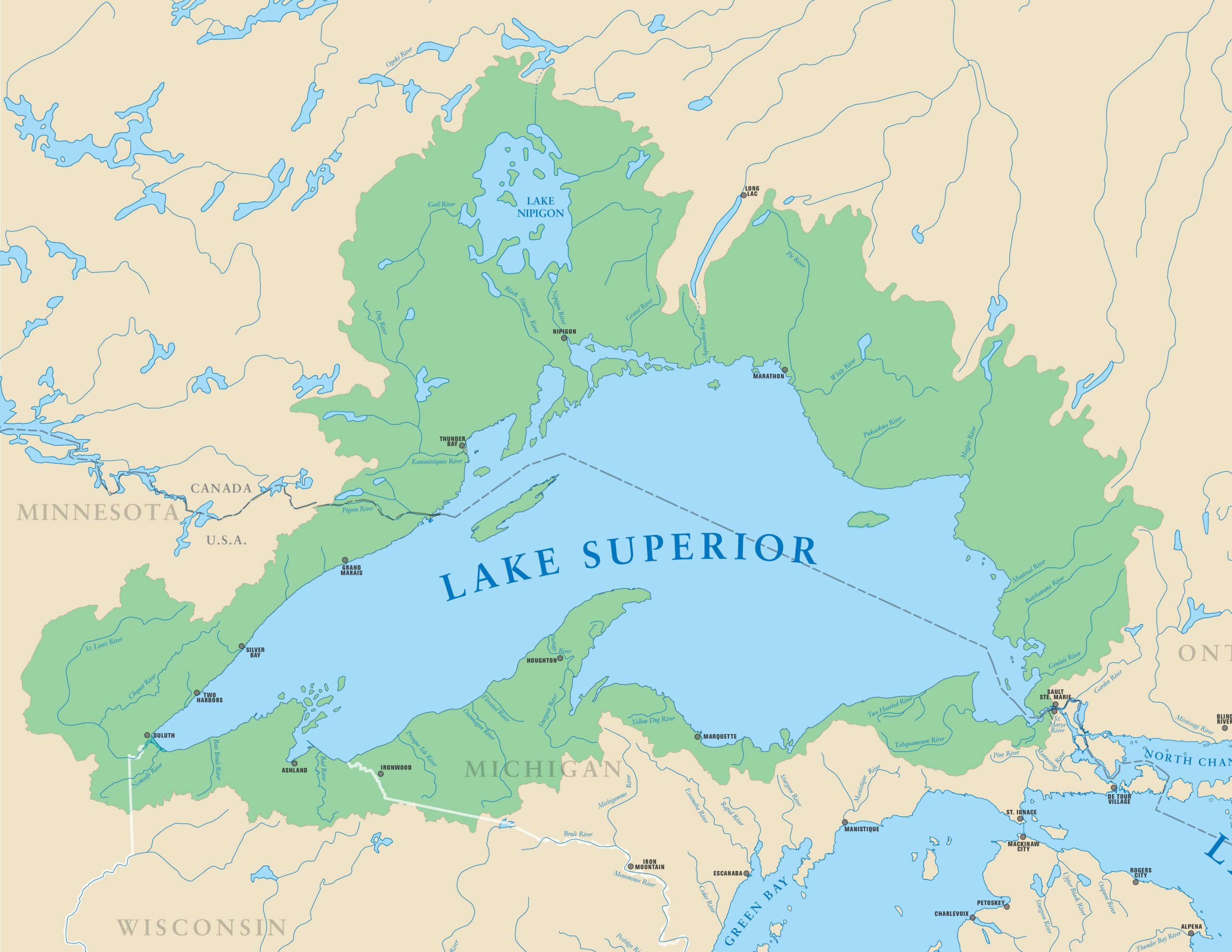
 Growing up, I lived in Casper, Wyoming, and still do. However, I always knew that I was born in Superior, Wisconsin. Superior always seemed like a fairly big place to me when my parents, Allen and Collene Spencer would take my sisters and me back there for visits. Then, in 2014 when my sister, Cheryl Masterson, our mom, and I went back after a number of years away, I was rather surprised at how small Superior seemed…especially in relation to Duluth, Minnesota, which had always seemed like a sister-city to me. In reality, the two cities were originally sister-cities, but rivalries over the years changed all that and the change was evident when I was there in 2014.
Superior, Wisconsin, and Duluth, Minnesota, are the biggest cities on Lake Superior, together known as the “Twin Ports.” Back in the late 1800s and early 1900s, Superior actually had more people than Duluth, thanks to its booming role as a major shipping hub during the Great Lakes shipping expansion. At its peak in the early 1900s, Superior’s population topped 100,000, making it the largest city on the Great Lakes. Duluth was also an important port, but smaller at the time. The balance of population might have stayed that way if not for the long-standing rivalry between the two cities. It all began when Duluth wanted its own direct lake access, but it lacked a natural entry. The US government favored a cheaper plan to improve Superior’s access instead. Duluth fought back, and after a legal battle with Wisconsin leaders, some locals took matters into their own hands, secretly digging a canal at night. At the time of the final push to finish the canal, an injunction was on its way from Superior to stop the Duluth canal, but when it arrived, it was too late. By 1887, the US Army Corps of Engineers had taken control of building the lift bridge and canal, paving the way for the iconic Aerial Lift Bridge, 
 now on the National Register of Historic Places. This rivalry and the canal have been central to shaping both cities’ history and identity.
By the middle of the 20th century, Duluth’s population began to grow faster due to industrial development, especially in the iron ore mining and smelting industries, and its proximity to the Iron Range. This growth eventually made Duluth the larger city in the Twin Ports area. Today, Duluth remains the larger city in terms of population: about 87,680 residents in 2023 compared to Superior’s roughly 66,870. However, Superior remains the larger city in terms of land area (about 207.6 square miles vs. Duluth’s 80.2 square miles) and is the largest US city on the Great Lakes by land area. I don’t know if the land size really provides much consolation for the city of Superior, but the two cities seem to have worked things out…I guess. To the unsuspecting public, the two cities seem to function as one big city. the bridges that run between the two cities are always busy as people go back and forth to different businesses on both sides. The two main bridges connecting Duluth, Minnesota, to Superior, Wisconsin, are the John A Blatnik Bridge and the Richard I Bong Memorial Bridge. Opened in 1961, the John A. Blatnik Bridge carries Interstate 535 (I-535) over the Saint Louis Bay. It is a vital freight and commercial link between the Twin Ports, serving an average of 33,000 vehicles daily. The bridge is nearing the end of its service life, and a replacement project is planned, with construction expected to begin in 2026 and last until 2031. The new bridge will include a shared-use path and improved access to Superior. The Richard I Bong Memorial Bridge opened on October 25, 1984. It connects Duluth and Superior via US Highway 2. It spans approximately 
 11,800 feet, with about 8,300 feet over water, and rises 120 feet above the river to accommodate maritime traffic. This bridge handles about 16,100 vehicles daily and is currently the only pedestrian and bicycle crossing between the two cities. Together, the bridges give the two cities the feel of being one. I have family living in both cities, and when I think of them, it seems to me that they all live in the same city.


Leave a Reply