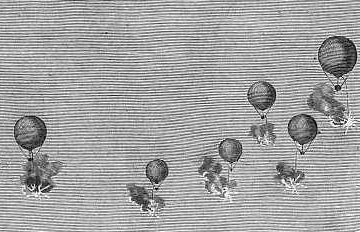
 When Japan sent a group of balloon bombs off toward the United States between November 1944 and April 1945 it seemed like a strange way to bomb another country, but the truth is that it was not even close to being the first time balloons were used in war. On August 22, 1849, Austria used around 200 pilotless balloons to carry out what is often regarded as the first remote aerial attack in history. This assault on Venice was part of a counteroffensive, as the city had overthrown Austrian rule a year earlier and briefly established itself as the Republic of San Marco.
While balloons were typically used for reconnaissance during war, the Austrian military decided to use them as bombers when they hit a stalemate in their attempt to retake Venice. It was a novel idea, and it seemed to be logical because of the unusual city they were dealing with. The city was already under siege, but its unique landscape…a series of 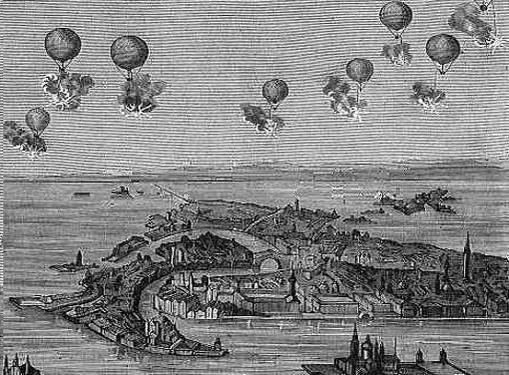 islands surrounded by shallow lagoons…offered strong natural defenses. That made it difficult to launch an effective attack by land or sea to force a surrender. Then, a young Austrian artillery lieutenant, Franz von Uchatius, came up with the idea of making paper balloons capable of carrying bombs with fuses set to detonate after half an hour. It was going to be “a one-shot chance” to make their play. In March 1849, Scientific American cited the Austrian Presse, stating that “they will be launched using electromagnetism through a long-isolated copper wire connected to a large galvanic battery placed on the shore.” Interesting!!
Russell Naughton, a research associate at Monash University in Australia, explained that each balloon carried 33 pounds of explosives. The idea was for the balloons to burst over Venice, dropping bombs on the fighters below. While some succeeded in making the trip, others were blown back over Austrian lines due to an unexpected wind shift. Historians noted that the balloons caused very little damage, 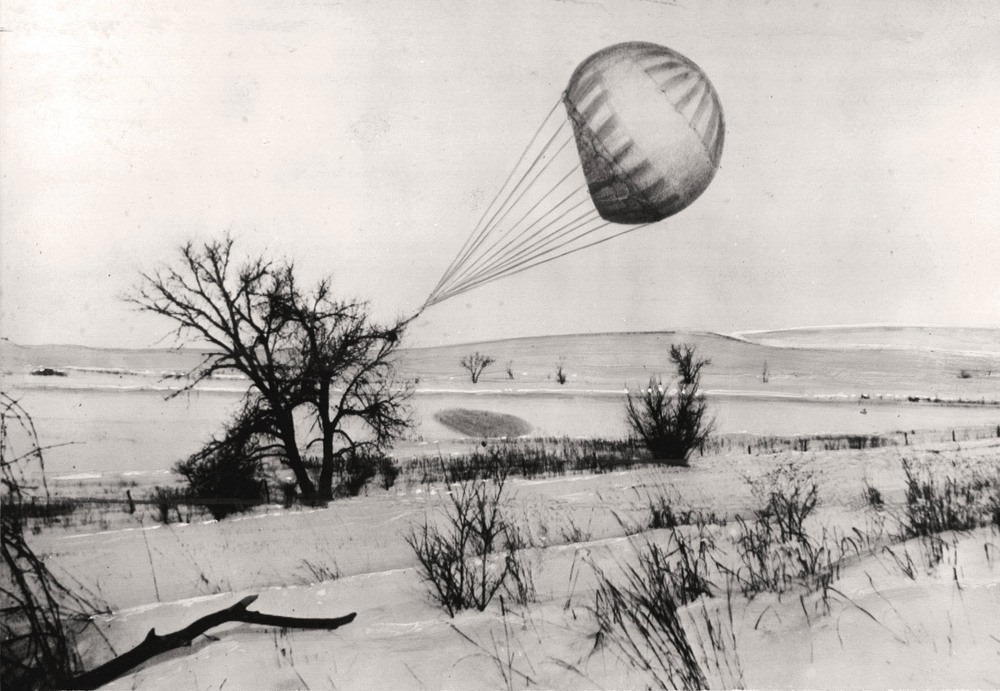 even though one landed in Venice’s main public square, Piazza San Marco. Balloons were simply not an effective aerial attack mode. Nevertheless, they might have had a psychological effect on the city, which soon surrendered while under siege.
Still, the idea of a “balloon bomb” didn’t die a quick death. In February 1863, a New Yorker named Charles Perley patented a hot air balloon designed to drop a bomb after a timer ignited its fuse. With that, the use of balloons for delivering bombs persisted into the next century. During World War II, Japan launched nearly 10,000 bomb-carrying balloons towards North America, leading to the few civilian casualties. in Oregon.


Leave a Reply