
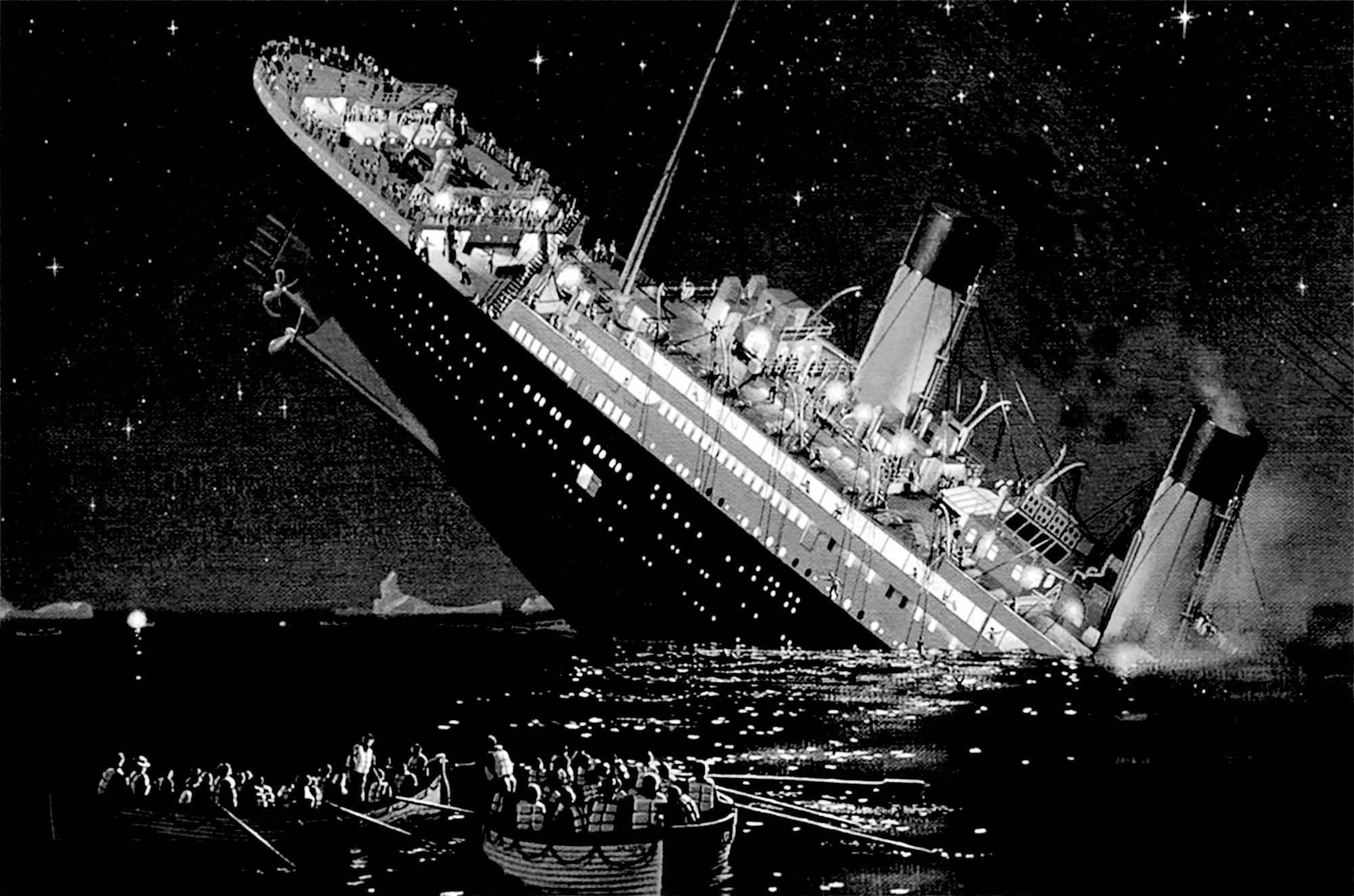
 His job as a stoker was the one, most likely to be fatal in a ship sinking…or at least very likely to be fatal, because when a ship sank or took damage, the seawater would flood the areas where the stokers worked first. Nevertheless, that was the job Arthur John Priest, an English fireman and stoker had, and one he managed to survive as he worked on four ships that eventually sank…with him onboard. Priest worked on the RMS Titanic, HMS Alcantara, HMHS Britannic and the SS Donegal. The fact that Priest survived all four of these sinkings, earned him the moniker “The Unsinkable Stoker.”
Priest was the son of Harry Priest, a laborer, and his wife, Elizabeth Garner, and one of twelve siblings. He was born in Southhampton, England on August 31, 1887. In 1915, he married Annie Martin (née Hampton) in Birkenhead. The couple had three sons…Arthur John, George, and Frederick Harry. The family spent several years living at 17 Briton Street in Southampton.
Priest worked as a stoker deep in the engine rooms of steam-powered ships. A stoker is “a person who tends the fire for the running of a boiler, heating a building, or powering a steam engine. Much of the job is hard  physical labor, such as shoveling fuel, typically coal, into the boiler’s firebox.” He was part of the “black gang” of 27 men that included six firemen, two trimmers, and a steward known as the “peggy,” who brought them food and drinks. The job was grueling, often done shirtless in the intense heat of the furnaces. During his time as a stoker, Priest survived four ship sinkings and two major collisions, most of which occurred during World War I. These included the RMS Asturias (collision on her maiden voyage, 1908), RMS Olympic (collision with HMS Hawke, 1911), RMS Titanic (sunk by an iceberg, 1912), HMS Alcantara (sunk in combat with SMS Greif, 1916), HMHS Britannic (sunk by a mine, 1916), and SS Donegal (torpedoed by SM UC-27, 1917). Remarkably, fellow Titanic survivors Archie Jewell and Violet Jessop also lived through the Britannic’s sinking with Priest, though Jewell later died on the Donegal. In 1917, Priest was awarded the Mercantile Marine Ribbon for his service in the Great War. After the sinking of the SS Donegal, Priest gave up working at sea and left his job as a stoker. He spent the rest of his life in Southampton with his wife, Annie, often saying that “no one wanted to sail with him after those disasters.” I suppose his “retirement” was a matter of necessity. When it became apparent that the company was having trouble filling the positions, it might have been easy to decide that the problem was superstition over what might be looked at as “bad luck” on the part of one stoker.

 Aside from his survival tales, little is known about his personal life. Reports say he passed away on February 11, 1937, at his Southampton home at the age of 49 due to pneumonia, with his wife Annie by his side. He was laid to rest at Hollybrook Cemetery in Southampton, England, and earned the nickname “the unsinkable stoker” for his remarkable stories of surviving at sea.


Leave a Reply