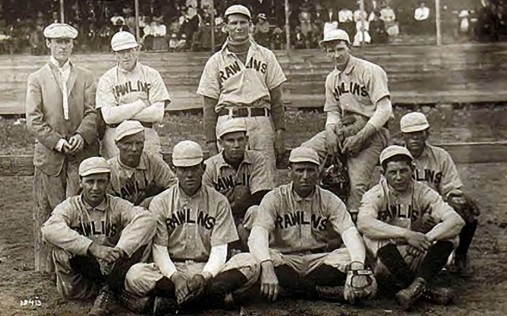
 The baddest baseball team. You might think they were a team from the MLB…a team that was so good that they beat everyone else around…a team that could not be stopped. You would be wrong. The “Baddest Baseball Team” was a term used to describe the 1911 Wyoming State Penitentiary All-Stars. They were the “baddest” ever assembled, because of who was on the team. The team had a murderer at shortstop, a burglar at third, and manning first base was a convicted rapist, and the team’s star player in right field had a date with the hangman before the season was scheduled to end. The Wyoming State Penitentiary All-Stars, at first glance, seemed like any other baseball team of their time. A photo from their 1911 season features a polished group in crisp uniforms, matching caps, and neatly arranged gloves and bats. However, a closer look unveils that one troubling reality. These men were hardened criminals.
Other teams have been given nicknames in the past, like the 1927 New York Yankees being called “Murderers’ Row,” but none were more truth than fiction, except for the 1911 Wyoming State Penitentiary team. Even that team name didn’t sound real, until the people looked at where the team was from. They found it hard to believe, but this was a real team, and the story is 100% true. What’s more, there is every reason to believe they were literally playing for their lives. The Wyoming State Penitentiary All-Stars was a baseball team made up of convicts who showed some aptitude for the sport. I suppose that a good prison team might be kept off of death row, “for the good of the team,” if for no other reason. The program was introduced by a newly appointed warden who loved the game. At its worst, it might have encouraged the same type of corruption that the previous warden had been accused of.
At that time in American history, baseball was rapidly gaining popularity across the nation. Kids dreamed of becoming legends like Honus Wagner, Ty Cobb, and Christy Mathewson. The Wyoming State Penitentiary, built in 1901 in Rawlins, was a grim and harsh facility where some inmates actually preferred execution over serving time. Lacking running water and electricity, the prison was a cold and dark place. Adding to the misery, millionaire Otto Gramm, with the aid of Warden JP Hehn, essentially ran the prison. Through a lessee program, inmates were forced to work for Gramm, making brooms in a makeshift factory for just 57 cents a day. Prisoners were often mistreated and barely given enough food to survive, while Gramm profited from around 60 dozen brooms produced daily by about 200 inmates. One inmate, Harry Pendergraft, who had been convicted of larceny, described the system as something from the dark ages. Finally in 1911, Governor Joseph Carey shut the program down and overhauled the system. He appointed Big Horn County Sheriff Felix Alston as the new warden, setting the stage for significant prison reforms. One of the biggest changes was the creation of the institution’s first baseball team. A passionate baseball fan, Alston believed a prison team could lift the spirits of the inmate-players and improve overall morale at the prison. What he didn’t anticipate was just how talented the team would turn out to be. The inmate All-Stars, aged 18 to 39, included shortstop Joe Guzzardo (manslaughter), first baseman Eugene Rowan (rape), third baseman John Crottie (grand larceny), center fielder Sidney Potter (forgery), second baseman Frank Fitzgerald (breaking and entering), and right fielder Joseph Seng (first-degree murder). The star pitcher, Thomas Cameron, 20, was a Tennessee coal miner with a powerful fastball and a criminal record that included sexual assault. The team’s coach, George Saban, was serving 25 years for shooting a sheepherder in the face and killing and burning two others during the Spring Creek raid, part of Wyoming’s range wars over grazing rights. Despite their criminal backgrounds, the team proved to be surprisingly skilled, particularly Seng.
Daniel C. Kinneman, owner of the Rawlins-based Wyoming Supply Co., proposed to Alston that the convicts play his company team, the Juniors, in a series of games that summer. Kinneman’s building, plumbing and supply company had a contract with the state penitentiary, so he knew of the new inmate team. He also was interested in seeing how his own ball club, a collection of promising rookies with a few seasoned veterans from the Rawlins city team sprinkled in, might fair against the cons. The Wyoming State Penitentiary All-Stars played their first game on a cloudless day July 18, 1911. The same day Seng was granted a stay of execution by the Wyoming Supreme Court while his appeal was heard. Seng celebrated by smacking two home runs as the “Cons” defeated the Juniors 11-1 in a rout played at the stockades on prison grounds.
Seng continued to work hard in baseball practice and became a model prisoner. When the date approached for the All-Stars’ final game of the season, Seng had hopes that his sentence might indeed be commuted. After all, his supposed execution date of Aug. 22 had come and gone and here he was about to play in another baseball game days later. Overland Park was the site of the fourth and final game between the WSP All-Stars and the Rawlins Juniors on Aug. 27. It would be the first time the cons would play in public. Security was tight. The WSP All Stars continued to beat the Juniors that summer.
Seng’s sentence remained unchanged, and at 2:45am on the day of his execution, he was fitted with a black hood. He stepped onto the trapdoor and pulled the cork on the water bucket. Moments later, Seng “fell five feet and was jerked into eternity at the end of a rope,” as described by the Carbon County Journal. His neck didn’t break, and he slowly strangled to death. At 2:54am, three doctors pronounced him dead. His body was handed 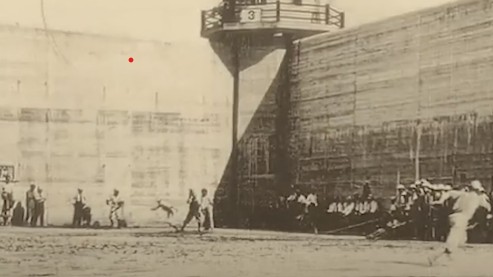 over to county undertaker H. Rasmussen, who reportedly promised to send it back to Pennsylvania for burial in his hometown, though this might not have occurred. A headstone with Seng’s details exists at the old “Frontier Prison” in Rawlins, while another marker in Allentown’s Sacred Heart of Jesus Catholic Cemetery bears his name but with an incorrect death date. Seng was the first person hanged at the Wyoming State Penitentiary. Eight more followed before the gallows were replaced by the gas chamber in 1936. In total, 14 men were executed at the state pen, while another 250 died from natural causes, suicide, or inmate violence before the prison closed in 1981.


Leave a Reply