typewriter
 My co-worker is a high school student named, Amanda Ingram. Amanda is also taking a college class through the Boces program this summer. She is taking Wyoming History, and she was required to write a paper concerning the boom and bust cycle in Wyoming, using newspapers from the 19th, 20th and 21st centuries. She was given a public website to use to locate news articles for her paper. That intrigued me, and I decided to check out the site. The site allows you to look by city, county, year, or simply by all newspapers. When I went in to look, I of course, went for the oldest newspaper they had.
What I found was so exciting. That first newspaper in Wyoming was The Chugg Water Journal, out of Fort Laramie, published on October 2, 1949. For those who live in Wyoming, spelling Chugwater…Chugg Water is very strange. That made me think, mostly about what Chugwater meant anyway, and why it might be written Chugg Water for the newspaper. The word “chug” is 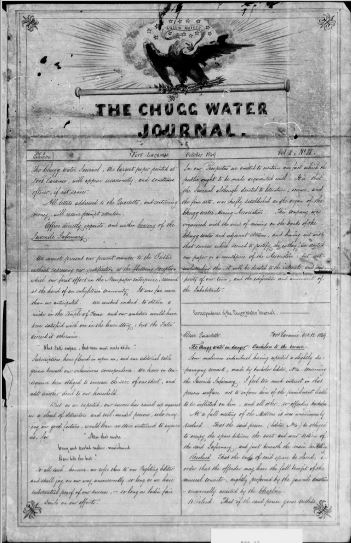 said to describe the noise that the buffalo or the falling chalk made when it hit the ground or fell into the water under the bluff, depending on which version of the legend you wish to believe. Because of that, the Indians began to call the area “water at the place where the buffalo chug.” The White Man adopted the Indian name and called the area “Chug Springs.” Chugwater Creek was named after Chug Springs, and from that came the name of Chugwater. Still, the reason for the name of the paper is speculation on my part. I am assuming that it was in an effort to remain more or less purist about the name, and since Chug Springs came first, that might be reason the paper was named the Chugg Water Journal.
Aside from the name of the paper, I was very interested in the fact that it was hand written…at least at first. Of course, I knew that many newspapers were hand written at first, because there was no such thing as a printing press, or even typewriters for a long time, but to be able to actually view a handwritten newspaper was very exciting to me. My inquisitive mind embarked on a different thought journey. If the newspaper were hand written, and the 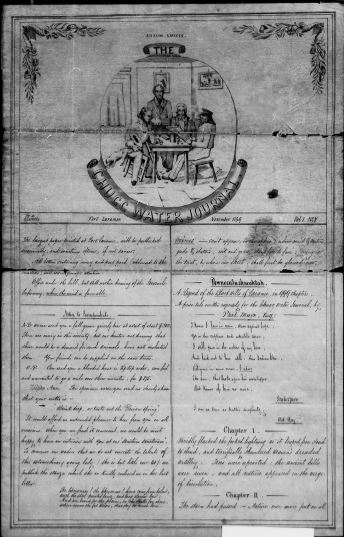 town had 50 families in it, all of whom wanted a paper, how long would it take to write all those papers up? And was it the same person doing it? Wow!! After a time, you would know the news by heart, and it would become seriously old news. Then, when you consider the fact that the paper was to “appear occasionally and sometimes oftener, if not sooner”…whatever that actually meant, the news became really old.
Still, the paper and its possible contents intrigued me. I started thinking about different dates and events in Wyoming’s history that might have appeared in that and other Wyoming newspapers. Would a first-hand account be more accurate that the history books? Even if history’s account is accurate, the newspapers would provide the feelings of the writer, and that is pure gold, because that makes it personal. I found myself feeling very excited about my future visits to this and other old and handwritten newspaper sites. I know that I will find many treasures.

